
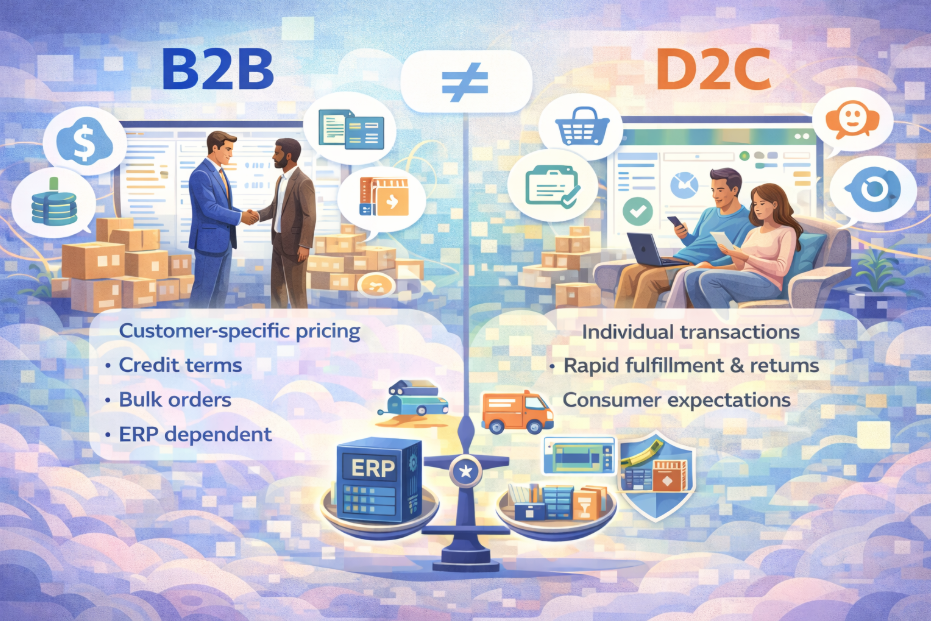
The Common Misunderstanding
As digital commerce has matured, many businesses have assumed that B2B ecommerce is simply a more complex version of direct-to-consumer (D2C) retail.
In reality, the two models operate under fundamentally different rules.
D2C platforms are designed for consumer behaviour.
B2B systems must support operational relationships between businesses.
When these differences are ignored, operational strain often follows.
Different Buyers, Different Behaviours
Consumer ecommerce focuses on individual transactions:
- A customer browses a product
- Adds it to a basket
- Completes checkout
- Receives delivery
Wholesale purchasing behaves differently.
Business buyers typically:
- Order repeatedly from the same supplier
- Purchase larger quantities
- Follow negotiated agreements
- Require account-level management
- Integrate purchasing into internal workflows
The buying journey is relationship-driven rather than purely transactional.
Pricing Structures Are Fundamentally Different
In D2C environments, pricing is usually simple:
- One public price per product
- Promotional discounts applied universally
- Dynamic pricing driven by marketing campaigns
Wholesale pricing is more complex.
Common structures include:
- Customer-specific price lists
- Tiered pricing based on order volume
- Contractual discounts
- Regional pricing agreements
- Negotiated product bundles
These rules must align closely with ERP data to maintain consistency.
Credit Terms Change the Transaction Model
Consumer ecommerce typically relies on immediate payment methods such as cards or digital wallets.
Wholesale transactions often operate on credit terms:
- Net 30 or Net 60 payment agreements
- Credit limits tied to customer accounts
- Invoice-based billing
- Payment reconciliation through finance teams
This shifts ecommerce from a simple checkout process to part of a broader financial workflow.
Ordering Behaviour Is Different
Consumer orders are generally small and varied.
Wholesale orders tend to be:
- High-volume
- Repeat purchases
- Based on previously negotiated catalogues
- Placed through quick reordering workflows
Features such as bulk ordering tools, account-level ordering permissions, and repeat order functionality become essential.
These are rarely priorities in consumer-focused platforms.
ERP Dependency Is Much Stronger
D2C platforms can often operate independently with lightweight back-office systems.
B2B commerce rarely has that flexibility.
Wholesale businesses rely heavily on ERP systems for:
- Inventory control
- Pricing governance
- Customer account management
- Order processing
- Financial reporting
As a result, B2B ecommerce must integrate closely with ERP to maintain operational accuracy.
The Operational Risk of Treating B2B Like D2C
When businesses attempt to force wholesale operations into systems designed primarily for retail, several problems often emerge:
- Pricing inconsistencies between systems
- Manual workarounds for account management
- Stock allocation conflicts
- Complicated reconciliation processes
- Increased administrative workload
These issues can undermine the efficiency gains that digital commerce was intended to deliver.
Different Models Require Different Systems
A more sustainable approach recognises the structural differences between B2B and D2C.
This typically involves:
- A wholesale-first platform designed around account-based trading
- ERP-centric architecture that maintains data integrity
- Separate systems optimised for consumer channels when required
- Integration layers that synchronise data across environments
This allows each model to operate according to its own rules without compromising operational stability.
For the practical checklist (trade login, price lists, credit accounts, case packs, backorders and invoices), see what changes when you sell to trade.
Supporting Both Channels Without Conflict
Many wholesale businesses now operate both B2B and D2C channels.
Success depends on recognising that these channels serve different purposes:
- B2B focuses on long-term trading relationships
- D2C focuses on consumer convenience and brand experience
When systems are structured appropriately, the two models can coexist without creating internal friction.
Conclusion
B2B ecommerce is not simply a more complicated version of consumer retail.
It is a distinct discipline shaped by:
- Complex pricing agreements
- Credit-based purchasing
- Relationship-driven buying behaviour
- Strong ERP integration requirements
Treating B2B and D2C as interchangeable often creates operational strain.
Businesses that recognise the differences — and implement systems designed for each model — are better positioned to grow sustainably across both channels.
If you are weighing that decision now, we have set out what a B2B ecommerce platform has to do that a D2C one does not, and the questions worth asking every vendor on your shortlist. If it is specifically the ordering side you are assessing — trade pricing, account terms, back orders — that is covered on B2B ordering platform.