
A B2B webshop and ecommerce platform for UK wholesalers
Trade customers do not shop the way consumers do. They log in to an account, expect the price they negotiated, order against terms rather than a card, and assume the website knows what is actually in the warehouse. A B2B webshop, or B2B ecommerce platform, is judged on how well it holds those rules — and almost all of them live in your ERP.
What a B2B platform has to do that a D2C one does not
Most ecommerce platforms can show a catalogue and take an order. The things that separate a wholesale platform from a retail one are commercial rules, not storefront features — and they are the reason B2B projects tend to fail late rather than early.
Pricing per customer
Prices are held per customer group, not published to everyone. A retailer logs in and sees the pricing agreed with them — the same figures the sales team would quote.
Accounts, not checkouts
Ordering happens against an account with agreed terms and credit limits. Card payment is an option rather than the assumption the whole flow is built around.
Back orders as normal trade
In wholesale, ordering what is not yet in stock is routine. Lines can be held and released when stock lands, rather than the order being blocked or silently trimmed.
Catalogue visibility by account
Not every customer should see every product. Ranges can be restricted by account, which matters for exclusives, licensed lines and territory agreements.
Repeat and bulk ordering
Trade buyers reorder known lines in quantity. The job is to make a large repeat order fast, not to merchandise a first-time visitor into a basket.
One catalogue, several stores
A trade store, a retail storefront and a second brand can run alongside each other on the same catalogue, with their own pricing and presentation.
The wholesale ordering portal your customers will actually use
The measure of a trade ordering portal is whether buyers stop phoning and emailing. They stop when the portal is faster and more trustworthy than the sales desk — which means it has to show the right price, the right availability and the right products, every time, without anyone in the office re-keying anything.
This is a summary. The ordering side has its own page: what a B2B ordering platform has to do covers the requirements in full, along with the honest difference between an ordering app, a trade portal and a B2B webshop — three words vendors use interchangeably and shouldn't.
Their price, on login
Customer-specific pricing comes from the ERP, so the portal and the sales team never quote different numbers.
Real availability
Stock is synchronised from the ERP rather than maintained separately on the website, which removes the main cause of overselling.
Orders land ready to pick
Orders flow into the ERP attributed to the right account with no manual rekeying, so the warehouse works from one queue.
Open around the clock
Independent retailers place orders in the evening after their own shop shuts. A portal takes those orders; a phone line does not.
We have also written about why so many wholesalers are still capturing orders on paper and spreadsheets, and what it costs, in offline wholesale order capture.
The ERP connection is the decision, not the storefront
B2B ecommerce projects rarely fail because the site looked wrong. They fail because two systems slowly stop agreeing with each other — prices updated in one place and not the other, stock that is right in the morning and wrong by lunchtime, orders that need checking before they can be picked. Whatever platform you choose, this is the part to interrogate.
One system of record
The ERP stays authoritative for stock, pricing, customers and orders. The platform presents that data rather than keeping a rival copy of it.
A maintained connector
Connections are a product we maintain, not a one-off build that goes stale when the developer who wrote it moves on.
Connect once, not many times
Channels connect through one hub instead of every system wiring directly to every other. The reasoning is in point-to-point integration risk.
How that connection is actually built — what moves between the systems, the four approaches to building it and what each costs — is set out in full on our ERP integration page.
We run maintained connectors for Brightpearl, SAP Business One and Caliq, plus Shopify, the Faire marketplace, Blue Alligator and structured file feeds. The full picture is on the integrations page.
How to shortlist a B2B ecommerce platform
Feature lists are close to useless at this stage, because every vendor's list is the same. These are the questions that actually separate them — and they are worth asking us as hard as anyone else. If you are still deciding between approaches rather than vendors, our comparison of the five ways UK wholesalers run B2B sets out who each one is wrong for, including us.
How does it reach our ERP?
Ask whether the connector exists today and is maintained, or whether it is a project. Ask what happens to it when the ERP is upgraded.
Are our trading rules configuration?
Price lists per customer group, minimum orders, back-order behaviour, restricted ranges. If these need custom code, every future change will too.
What happens when stock runs out?
A revealing question. The honest answer is "it depends how you trade" — so the platform should let you choose rather than impose one behaviour.
Who answers when it breaks?
Find out whether the platform, the connector and the ERP relationship sit with one team or three. Three is where the finger-pointing starts.
Can it run D2C too?
If retail is on the roadmap, adding it later on the same catalogue is far cheaper than running a second platform in parallel.
What does year three look like?
Ask about the cost of change, not just the cost of launch. Our take on where cheap quotes hide it is in the hidden cost of cheap integrations.
What should this actually cost?
The six drivers that move the number on a B2B platform and its ERP integration, what is one-off against recurring, and six questions that make competing supplier quotes comparable. No email required.
B2B platforms we run for UK wholesalers
Live trade platforms, each with its own pricing structure, account rules and ERP behind it.
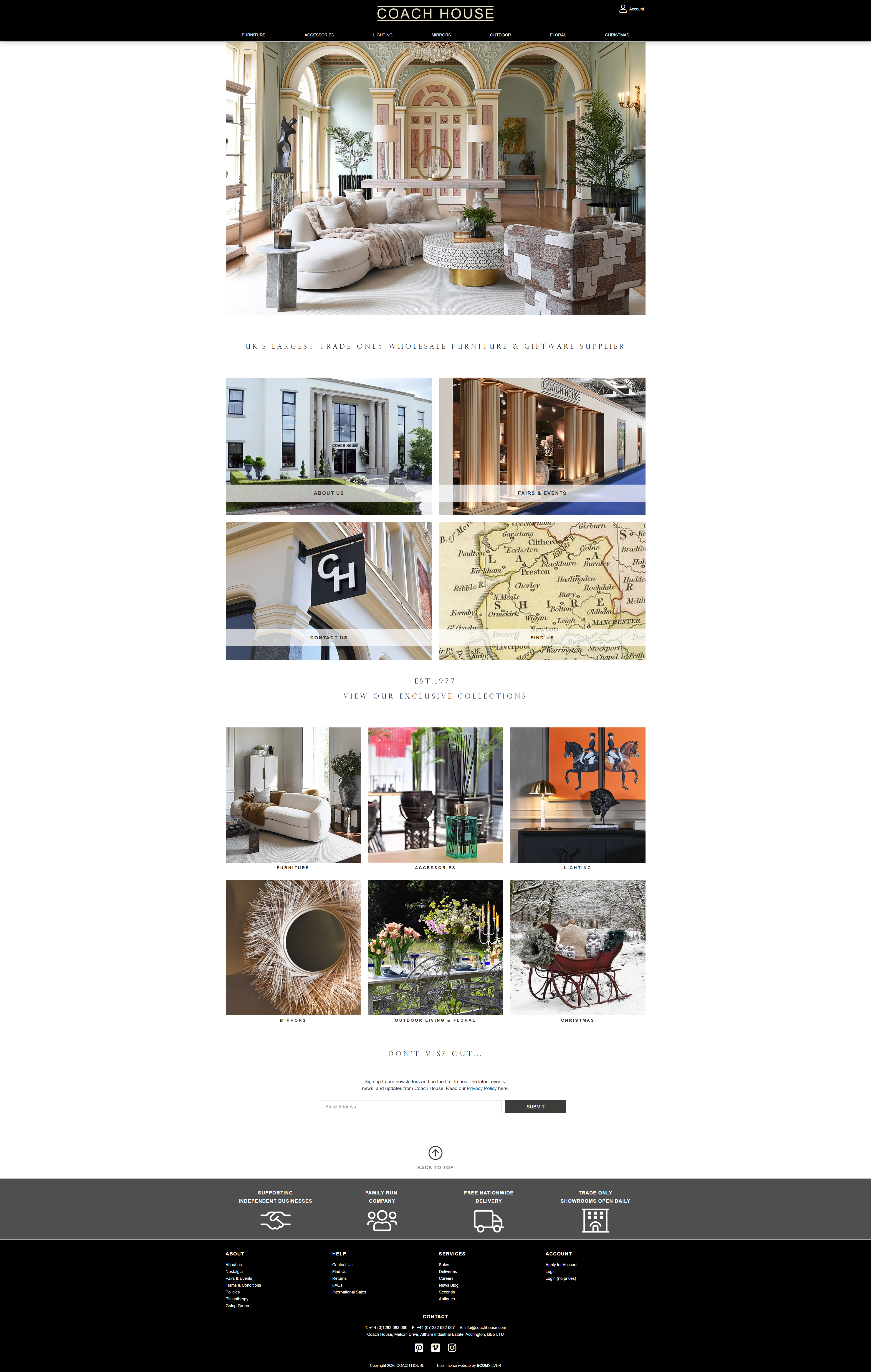

Coach House
UK's largest trade-only furniture and giftware supplier. Family-run since 1977 with 60 themed showrooms in Lancashire and over 600,000 sq ft of warehousing. B2B platform handles complex trade pricing across furniture, lighting, accessories, and seasonal ranges.
Visit website

White Leaf
Contemporary jewellery and accessories wholesaler with two distinct brands: White Leaf and Last True Angel. Nature-inspired designs in sterling silver and stainless steel. Trade platform supports account-based ordering with tiered pricing for retailers.
Visit website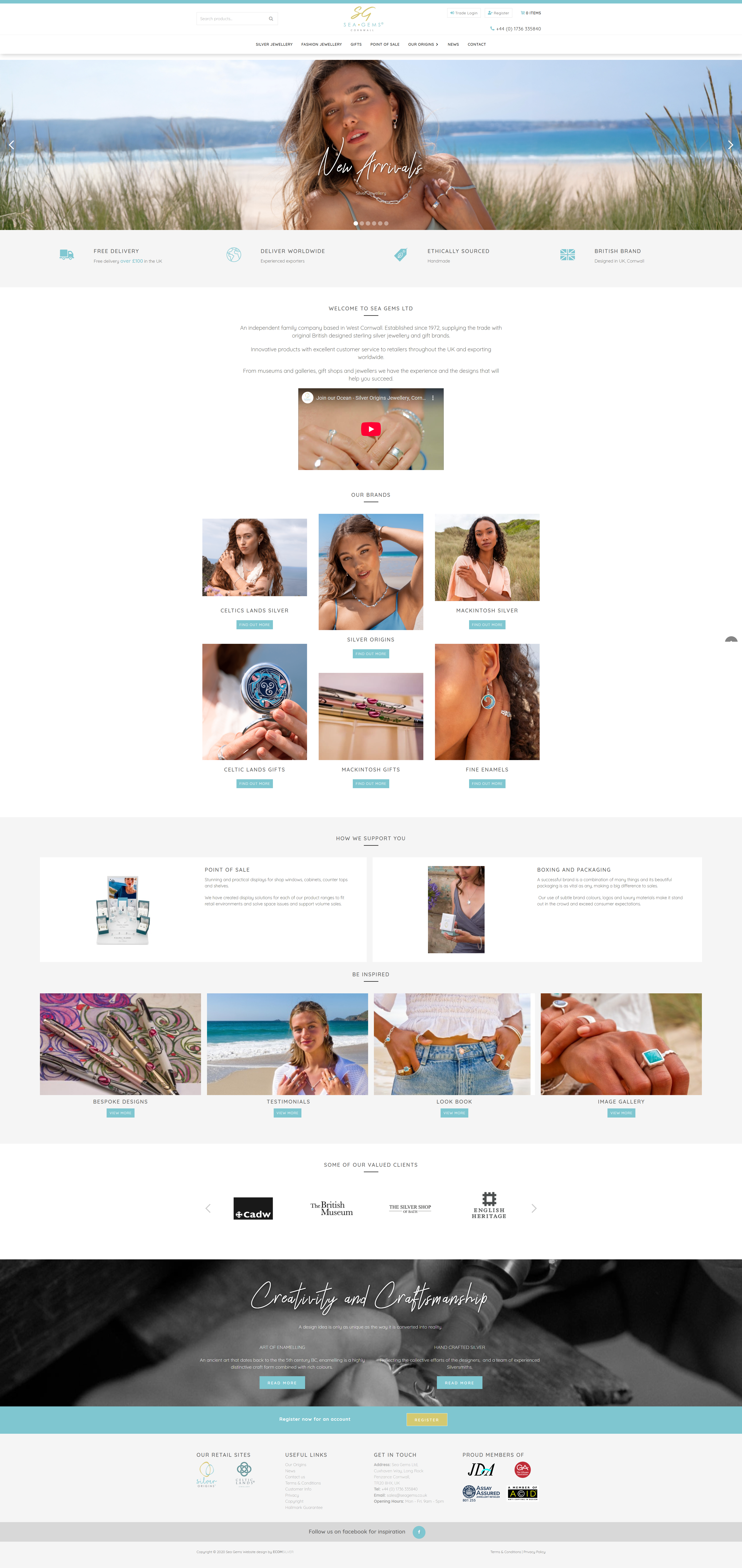

Sea Gems
Independent family jewellery business established in 1972, based in West Cornwall. Specialises in British-designed sterling silver and fine enamels. B2B platform serves museums, galleries, gift shops, and jewellers across the UK and internationally.
Visit website

Museums & Galleries
UK's leading publisher of licensed art greeting cards and gift stationery. Exclusive partnerships with V&A, Tate, Natural History Museum, British Library, and character brands. Trade platform manages complex licensing and retailer account structures.
Visit websiteMore detail on how these are put together is on the use cases page, and the reasoning behind the platform itself is in why Coretonomy B2B.
B2B ecommerce platform questions
What is a B2B ecommerce platform?
A B2B ecommerce platform is trade ordering software for businesses that sell to other businesses rather than to consumers. The difference from a D2C store is not the storefront but the rules underneath it: customers log in to an account, see prices negotiated for them, order against agreed terms rather than paying by card at checkout, and expect the catalogue and stock to match what the sales team would tell them on the phone. Those rules normally live in the ERP, so a B2B platform is judged mostly on how well it stays in step with it.
How do you choose a B2B ecommerce platform?
Start from your ERP rather than the feature list. Most B2B platforms can show a catalogue and take an order; the ones that fail in year two are the ones that could not keep customer-specific pricing, stock and account terms in step with the system of record. Ask how the platform connects to your ERP, who maintains that connection, what happens when the ERP is upgraded, and what the platform does when stock runs out mid-order. Then check the commercial rules you actually trade on — price lists per customer group, minimum orders, back orders — are configuration rather than custom development.
Can we just use a D2C platform like Shopify for B2B?
Sometimes, and we say so honestly. A D2C platform with wholesale apps can work where trade pricing is simple and volumes are low. It gets expensive where pricing is negotiated per customer, where orders need to sit against account terms, or where the ERP has to remain the system of record — because each of those becomes an app, an integration, or a manual process. We have written up where the line falls in our post on whether to use Shopify for B2B.
Does a B2B ecommerce platform have to connect to our ERP?
Not technically, but in practice this is the decision that determines whether the project lasts. If the platform holds its own prices and stock, someone has to keep two systems agreeing with each other, and that job never gets easier as the catalogue grows. Coretonomy keeps the ERP as the system of record and synchronises through an Integration Data Hub, so pricing, stock and customer accounts have one home.
Which ERPs do you connect to?
We run maintained connectors for Brightpearl, SAP Business One and Caliq, plus Shopify, the Faire marketplace, Blue Alligator and structured file feeds. Other systems are scoped as bespoke work rather than presented as an existing connector.
How does customer-specific pricing work online?
Prices are held per customer group in the ERP and synchronised to the platform, so a trade customer logs in and sees their own pricing rather than a published list. Retail shoppers on a D2C storefront only ever see retail pricing, because that is a separate price list.
What happens when an item is out of stock?
That depends on how you trade, which is why it is a setting rather than a fixed behaviour. Lines can be held as back orders and released when stock arrives, or availability can be enforced at the point of ordering. Because stock levels come from the ERP rather than being maintained separately on the website, the main cause of overselling is removed.
Can we run trade and retail on the same platform?
Yes. A B2B trade store and a D2C retail storefront can run on the same platform against the same catalogue, with separate pricing, separate customer accounts and separate presentation. Several of the businesses we work with run both, and some run more than one brand alongside each other.
Which B2B ecommerce platform features actually matter?
The ones that encode your trading rules: customer-specific pricing, ordering on account against credit terms, back orders, quantity and catalogue rules, rep ordering, and a reliable ERP connection. Most other items on a feature-comparison sheet are cosmetic or can be added later. The practical test is not whether a feature exists but how it behaves against your own awkward cases — your most complicated price list, your strangest quantity rule — and feature lists cannot tell you that.
Ready to build your B2B platform?
We start with your current systems, trading requirements, and customer needs, then design a wholesale platform that works for your business. Pricing is set out here.