
Why Fast Change Feels Productive
In digital commerce and technology projects, speed is often equated with progress.
Launching new platforms, features, or channels creates visible momentum. Stakeholders see activity, milestones are achieved, and the business appears to be advancing.
However, speed alone does not guarantee stability.
In established wholesale and retail organisations, rapid change can introduce hidden risks that only surface later.
The Difference Between Movement and Progress
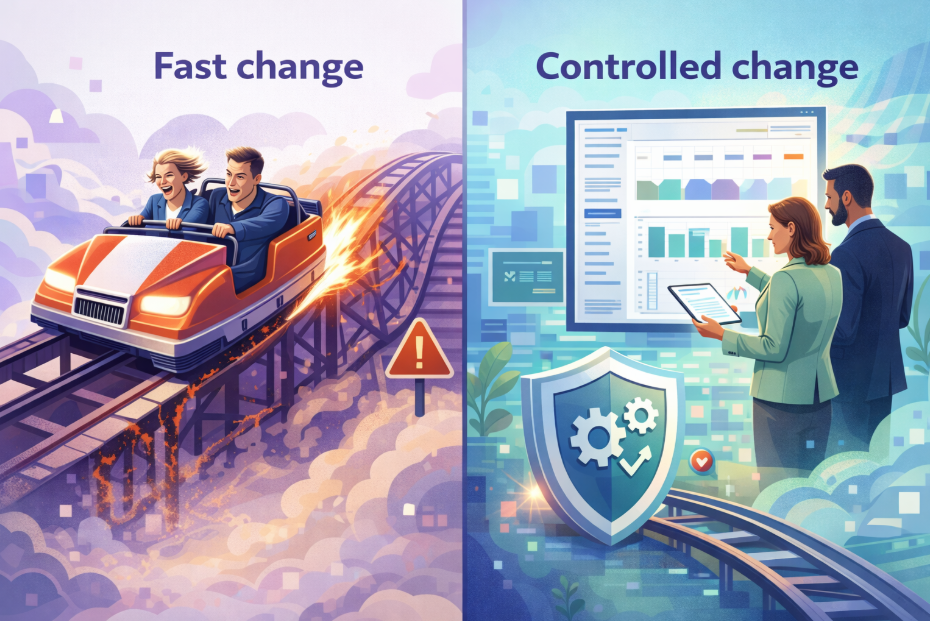
Fast change creates movement.
Controlled change preserves progress.
Without governance, rapid initiatives can:
- Disrupt operational workflows
- Introduce data inconsistencies
- Overload support teams
- Create integration conflicts
- Reduce confidence in systems
These effects may not be immediately apparent during rollout but can emerge as transaction volumes increase.
We explore a closely related failure pattern in Replatforming Isn't Transformation — movement that looks like progress but does not change the underlying operational reality.
Why Established Businesses Face a Different Challenge
Startups can tolerate instability because they have fewer legacy processes and dependencies.
Established businesses operate differently. They rely on:
- ERP systems as systems of record
- Mature fulfilment processes
- Customer agreements and pricing structures
- Financial controls
- Supplier coordination
Changes in one area ripple across many others.
The goal is not just to launch something new — it is to ensure the existing operation continues to function reliably.
The Six-Month Test of Any Project
A useful way to evaluate change is to look beyond launch.
Ask: Will the business still operate smoothly six months from now?
Many projects succeed technically but create long-term strain through:
- Increased manual intervention
- New reconciliation tasks
- System performance issues
- Training gaps
- Process misalignment
Controlled change focuses on outcomes over time, not just immediate delivery.
Change Control as Risk Management
Change control is often misunderstood as bureaucracy.
In reality, it is a structured approach to risk management.
Effective change control involves:
- Assessing operational impact before implementation
- Coordinating updates across systems
- Maintaining data integrity
- Planning rollback strategies
- Communicating changes clearly to affected teams
This discipline reduces the likelihood of unintended consequences.
This is not only a matter of opinion. The IT Process Institute's Visible Ops research — the result of more than three years studying high-performing IT operations and security organisations — concluded that almost 80% of outages are self-inflicted, caused by the way changes are made rather than by hardware or attack. That finding dates from the mid-2000s, and the more recent measurement points the same way: the Uptime Institute's Annual Outage Analysis 2025 reported that nearly 40% of organisations had suffered a major outage caused by human error in the previous three years, and that 85% of those incidents came down to staff not following procedures, or to the procedures themselves being inadequate — that survey covers data centre and digital infrastructure operators rather than wholesalers, but the mechanism is not specific to the industry. From the other direction, Prosci's Best Practices in Change Management benchmarking found that 88% of initiatives with excellent change management met or exceeded their objectives, against 13% of those with poor change management.
None of that research is about wholesale ecommerce specifically, and the Prosci figures measure organisational change management rather than the narrower technical discipline described above. The pattern across all three is still the useful part: when outage and project-failure causes are examined rather than assumed, the decisive factor is consistently how the change was introduced, not what was being changed. For an ERP-centric business, that is the practical case for change control — not caution for its own sake, but the largest single influence on whether a change survives contact with the operation.
The Role of ERP in Change Sensitivity
ERP-centric organisations are particularly sensitive to uncontrolled change.
Because ERP governs stock, pricing, customers, and financial data, disruptions here can propagate across all channels.
For example:
- Incorrect stock synchronisation can halt fulfilment
- Pricing errors can damage margins
- Customer data issues can affect billing and service
Maintaining ERP stability while introducing innovation elsewhere requires deliberate pacing.
This is why ERP has to remain the trusted system of record even as everything around it changes — see ERP Data Trust: Building Confidence for Commercial Decisions for what that trust actually depends on.
Pacing as a Commercial Decision
Change is not solely a technical matter.
Decisions about when and how quickly to implement initiatives affect revenue, customer satisfaction, and operational efficiency.
Pacing must consider:
- Seasonal demand patterns
- Staffing capacity
- Inventory cycles
- Supplier commitments
- Customer expectations
Introducing major changes during peak trading periods, for example, can amplify risk significantly.
Controlled Change Enables Sustainable Innovation
Slower, structured implementation often delivers better long-term results than rapid, uncoordinated rollout.
Benefits include:
- Higher system reliability
- Reduced disruption to daily operations
- Improved user adoption
- Lower support burden
- Greater confidence in data
Controlled change allows innovation to accumulate without destabilising the business.
Avoiding the Cycle of Launch and Repair
Without change discipline, organisations can fall into a recurring pattern:
- Rapid launch of new capability
- Operational issues emerge
- Resources shift to firefighting
- Strategic initiatives stall
- Confidence declines
Breaking this cycle requires prioritising stability alongside innovation.
Conclusion
Fast change can create the appearance of progress, but uncontrolled speed often introduces risks that undermine long-term success.
For established wholesale and retail businesses, the true challenge is not starting projects — it is ensuring the organisation continues to operate smoothly months after implementation.
Controlled change protects progress by aligning technical initiatives with operational realities and commercial priorities.
In complex ERP-driven environments, pacing decisions are as much about safeguarding the business as they are about delivering new capabilities.
Change Control in Wholesale eCommerce: Common Questions
What actually causes most unplanned system outages?
The way changes are made, rather than hardware failure or attack. The IT Process Institute's Visible Ops research concluded that almost 80% of outages are self-inflicted, and that conclusion has held up. The Uptime Institute's Annual Outage Analysis 2025 found that 85% of human-error outages came down to staff not following procedures or to the procedures being inadequate in the first place. That survey covers digital infrastructure operators rather than wholesalers, but the mechanism is the same: the change itself is rarely the problem, the process around it is.
Does change control slow down innovation?
Not in outcome terms. Prosci's Best Practices in Change Management benchmarking found that 88% of initiatives with excellent change management met or exceeded their objectives, against 13% of those with poor change management. The discipline is what makes a change stick rather than something competing with speed — though note that Prosci is measuring organisational change management, which is broader than the technical change control an ERP integration needs.
How is change control different from just having a rollback plan?
A rollback plan is one component of it. Full change control also covers assessing the operational impact before implementation, coordinating the change across every affected system, maintaining data integrity through it, and communicating it clearly to the teams it will touch. Rollback is the safety net, not the whole process — and a rollback plan that has never been rehearsed against live ERP data is closer to an intention than a control.
Who should own pacing decisions for ERP-linked changes — technical teams or commercial leadership?
Both contribute, but ultimately it is a commercial call. Technical teams are best placed to assess feasibility and risk, but deciding when to introduce a change — relative to seasonal demand, staffing capacity and customer expectations — is a business decision with commercial consequences. If that decision sits only with the technical team, pacing tends to follow delivery readiness rather than trading conditions.
If Brightpearl is your operational backbone, see how the Brightpearl integration hub keeps it the system of record while B2B, D2C and marketplace channels change around it.