
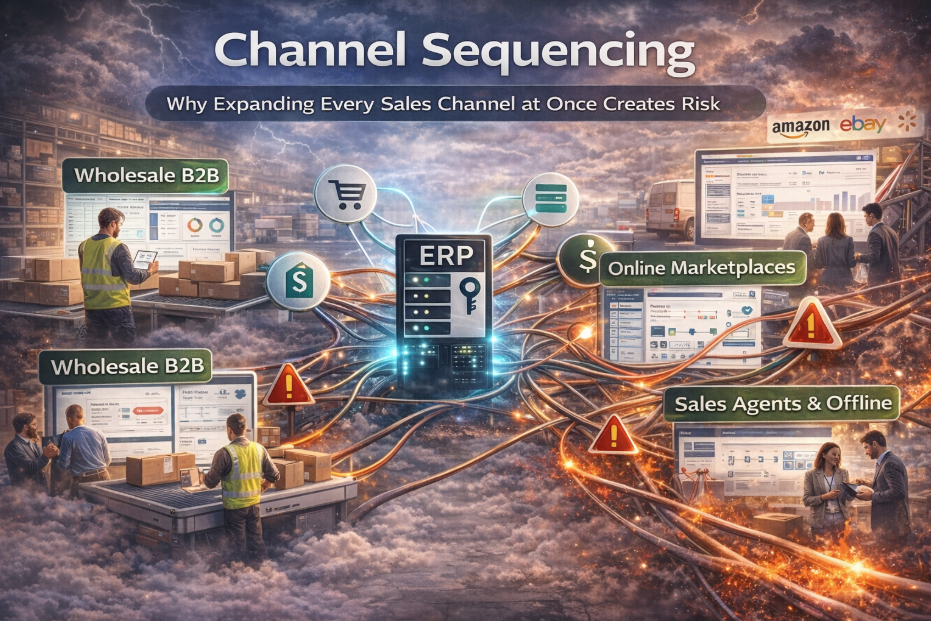
More Channels Does Not Automatically Mean More Control
As digital commerce options expand, many wholesale and retail businesses feel pressure to be present everywhere:
- B2B ecommerce
- Direct-to-consumer (D2C)
- Online marketplaces
- Sales agents and offline channels
While each channel offers growth potential, expanding across multiple fronts simultaneously can introduce operational strain faster than revenue gains.
Growth without sequencing often reduces control.
Different Channels Create Different Operational Pressures
Each channel operates with distinct expectations and workflows.
Wholesale (B2B)
- Customer-specific pricing
- Credit terms and negotiated agreements
- Bulk orders
- Account-based relationships
- ERP-dependent processes
Direct-to-Consumer (D2C)
- Individual transactions at higher volume
- Rapid fulfilment expectations
- Returns handling
- Consumer-grade customer service
- Marketing-driven demand spikes
Marketplaces
- Strict service-level requirements
- Competitive pricing pressure
- Platform rules and penalties
- External control over customer experience
- Complex inventory synchronisation
Managing one of these environments is challenging. Managing all simultaneously multiplies complexity.
The structural differences between wholesale and D2C in particular run deeper than most businesses expect — B2B vs D2C Ecommerce: Why Wholesale Needs a Different Platform sets out the specifics.
Why Expanding Too Quickly Dilutes Control
Operational systems — particularly ERP, fulfilment, and customer service — have finite capacity.
When multiple channels scale at once:
- Stock allocation becomes harder to manage
- Pricing consistency is harder to maintain
- Service teams face unpredictable workloads
- Systems experience increased transaction volume
- Exception handling increases
Without deliberate sequencing, businesses may find themselves reacting to problems rather than executing strategy.
Commercial Strategy Should Drive Channel Order
Channel expansion is not just a technical decision. It is a commercial one.
Key considerations include:
- Which channel aligns best with existing strengths?
- Which introduces the least operational disruption?
- Which delivers the most predictable revenue?
- Which requires the least structural change?
Answering these questions helps determine the most sustainable order of expansion.
Sustainable Growth Follows a Deliberate Path
Successful omnichannel businesses often expand in stages rather than launching everything simultaneously.
A typical progression might involve:
- Strengthening core wholesale operations
- Introducing D2C where fulfilment and support capacity allow
- Adding marketplaces once stock visibility and pricing control are robust
This staged approach allows systems and teams to adapt gradually.
Each new channel builds on stable foundations rather than competing for attention and resources.
The Risk of Enthusiasm-Driven Expansion
Digital initiatives are often driven by opportunity — a new marketplace opens, competitors launch D2C, customer demand appears.
While responsiveness is valuable, enthusiasm-driven expansion can outpace operational readiness.
Consequences may include:
- Overselling due to stock inconsistencies
- Pricing conflicts across channels
- Service delays damaging customer relationships
- Increased returns and disputes
- Internal stress on teams
These issues can undermine the very growth the new channels were meant to achieve.
The upside of multichannel selling is real, although the number most often quoted for it deserves a caveat: the widely repeated claim that sellers on three or more channels generate 143% more revenue comes from a multichannel listing vendor's analysis of its own 1,160 merchants, so it is directional rather than independent. The operational downside has been measured far more rigorously. Gruen and Corsten's worldwide study of retail out-of-stocks in fast-moving consumer goods put the industry average at 8.3%, and calculated that retailers lose around 4% of annual sales to items that are not on the shelf when the customer wants them. In a field experiment within the same research, the categories a retailer ordered manually ran at 11.7% out of stock, while categories on automated replenishment ran at 3.1% — a reduction of more than 70% (Gruen & Corsten, A Comprehensive Guide to Retail Out-of-Stock Reduction, 2008).
The relevance to sequencing is direct. Each new channel multiplies the number of places stock has to be right at the same moment, and it is manual reconciliation — the workaround teams reach for when a channel arrives before the systems are ready — that carries the higher failure rate. Expansion that outpaces operational readiness does not only risk the new channel. It degrades availability on the channels already running.
Sequencing Protects ERP Stability
ERP systems sit at the centre of stock, pricing, and order management.
Rapid multi-channel expansion increases the load on ERP integrations and data flows.
A sequenced approach allows:
- Validation of integration behaviour
- Adjustment of processes before scaling further
- Monitoring of performance under increased volume
- Controlled refinement of pricing and allocation rules
This reduces the likelihood that growth destabilises core operations.
Coordination Between Commercial and Operational Teams
Effective channel sequencing requires collaboration across departments:
- Sales and marketing define demand opportunities
- Operations assess fulfilment capacity
- Finance evaluates margin implications
- Technology teams ensure system readiness
When decisions are made in isolation, misalignment can lead to avoidable friction.
A coordinated approach aligns commercial ambition with operational reality.
This is also where feature chasing tends to creep in — Feature Chasing in eCommerce covers why new capability without operational readiness produces the same dilution of control that unsequenced channels do.
Conclusion
Not every sales channel needs to grow at the same pace.
Wholesale, D2C, and marketplaces place distinct demands on stock management, pricing governance, service teams, and systems.
Expanding across too many fronts simultaneously can dilute control and increase risk.
Sustainable omnichannel growth typically follows a deliberate sequence — prioritising stability, capacity, and long-term operational coherence over short-term enthusiasm.
Channel Sequencing: Common Questions
How much revenue can unsequenced multichannel expansion actually cost?
There is no published figure for multichannel wholesale specifically, and the percentages that circulate tend to come from inventory software vendors rather than independent research. The closest rigorous measure is out-of-stock research: Gruen and Corsten found retailers lose around 4% of annual sales to items not being on the shelf, and that categories ordered manually ran at 11.7% out of stock against 3.1% for categories on automated replenishment. Manual reconciliation is what a new channel usually forces on a team that was not ready for it.
If multichannel growth is genuinely more profitable, why sequence it at all?
Because the uplift is conditional on operational readiness, and the best-known figure for it is weaker than it looks — the widely repeated claim that sellers on three or more channels earn 143% more revenue comes from a multichannel software vendor analysing its own customer base. Add channels faster than stock, pricing and service capacity can absorb them and the same expansion that should grow revenue starts eroding it through overselling and reconciliation work instead.
Which channel should a wholesale business add first?
Typically the one requiring the least structural change from existing operations — often D2C, once fulfilment and support capacity allow, with marketplaces added only after stock visibility and pricing control are already robust across the first two channels. Marketplaces impose the strictest service levels and the least forgiving penalties, so they benefit most from being last.
How do we know if we're ready to add another channel?
If your ERP, fulfilment and service teams are handling existing channels without regular exception handling or manual workarounds, you likely have the capacity headroom. If those teams are already reactive, adding another channel usually makes that worse rather than better — the new channel inherits the workarounds rather than justifying the fix.