
The Pattern Behind Most Failed Wholesale eCommerce Projects
When digital commerce projects fail in established wholesale and retail businesses, the post-mortem rarely blames ambition.
It usually comes down to something quieter — and more dangerous:
The ERP system was treated as something to "connect later."
That decision — often made early, often made casually — is where operational risk begins to compound.
This isn't a fringe problem. Panorama Consulting's studies of ERP outcomes consistently find that around two-thirds of projects fall short of their original objectives. And in Panorama's analysis of ecommerce implementation failure specifically, the most frequently cited cause of projects exceeding budget is the unexpected addition of new technology requirements — integrations, reporting needs and dependencies that weren't in the original design.
Read that back and it describes a sequencing problem rather than a software problem. The ERP relationship gets defined after the commerce platform has already been chosen, and the cost of that ordering arrives later, as scope.
ERP Is Not "Just Another System"
In early-stage ecommerce brands, the website often is the business.
In established wholesale operations, that is not the case.
ERP is where:
- Stock truth lives
- Pricing structures exist
- Customer agreements are defined
- Order history resides
- Financial reporting originates
It is the operational core, not a peripheral tool.
Treating ERP as secondary to ecommerce architecture reverses the natural hierarchy of the business. And that is where instability starts.
What "ERP-Last" Architecture Looks Like in Practice
Wholesale businesses rarely set out to create risk. It happens gradually through decisions that look harmless in isolation.
ERP-last typically looks like this:
- An ecommerce platform is selected based on front-end features
- Sales teams push for rapid launch
- ERP integration becomes a "phase two" concern
- Workarounds are introduced to fill gaps
- Data starts moving between systems through scripts, exports, or manual handling
At this point, the ecommerce platform is no longer an extension of operations.
Operations are now compensating for ecommerce.
That is the reversal that causes stress inside established businesses.
The Hidden Costs of ERP-Last Thinking
The early signs are subtle:
- Stock mismatches between channels
- Pricing inconsistencies
- Order corrections after submission
- Finance teams reconciling discrepancies
- Customer service firefighting avoidable issues
None of these feel like "system failure."
They feel like operational friction.
But friction scales.
As channels expand — marketplaces, D2C, sales agents, trade shows — every weak integration point becomes a multiplier of risk.
Eventually, growth itself becomes the source of operational strain.
If any of this sounds familiar, it's worth reading operational debt — the hidden risk inside growing wholesale businesses: the same pattern, described from the finance and operations side rather than the integration side.
Why ERP-First Reduces Risk
An ERP-first approach starts from a different premise:
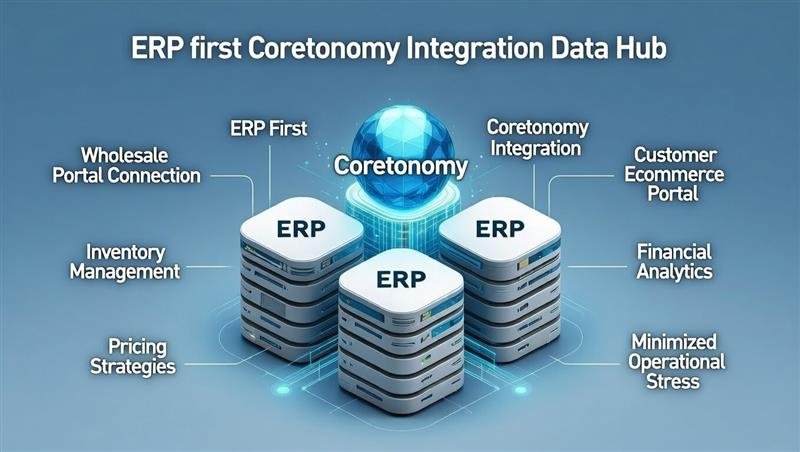
The ERP system is the system of record. Channels must adapt around it — not the other way around.
This changes the structure of the project:
- ERP data models are respected, not bypassed
- Integration architecture is designed early, not retrofitted
- Data flows are centralised rather than point-to-point
- Channel expansion becomes repeatable, not experimental
Instead of ecommerce driving operational change, integration architecture absorbs change safely.
That is the difference between scaling activity and scaling stress.
ERP-First Does Not Mean Slow
A common misconception is that ERP-first thinking delays progress.
In reality, it prevents rework.
When ERP is sidelined, projects often appear fast — until:
- Integration rebuilds are required
- Manual processes must be automated later
- Data integrity issues require correction
- Teams lose confidence in the system
ERP-first projects may look more deliberate early on, but they avoid the destabilising second wave of "fixing what we launched too quickly."
Wholesale Growth Is Operational Growth
Consumer ecommerce tolerates experimentation.
Wholesale operations do not.
Established businesses carry:
- Customer agreements
- Pricing tiers
- Credit terms
- Fulfilment complexity
- Accounting structures
Digital growth that ignores these realities doesn't create innovation.
It creates operational drag.
ERP-first architecture acknowledges that growth is not just about adding channels — it is about protecting the machine that already works.
It's also why we don't run wholesale operations on retail-first platforms — see do we use Shopify for B2B? for how this plays out with a specific platform.
The Real Question to Ask Before Any eCommerce Project
Instead of asking:
"How quickly can we launch?"
Established wholesale businesses should ask:
"Does this architecture keep ERP central as we grow?"
That question filters out high-risk approaches immediately.
Because in wholesale, ecommerce success is not measured by launch speed.
It is measured by whether operations remain stable six, twelve, and twenty-four months later.
Conclusion
Most wholesale ecommerce failures are not technology failures.
They are architecture sequencing failures.
ERP-last introduces fragility.
ERP-first introduces control.
And in established businesses, control is what makes growth sustainable.
ERP-First eCommerce: Common Questions
What is ERP-first ecommerce?
An architecture where the ERP remains the system of record — stock truth, pricing structures, customer agreements, order history — and every sales channel adapts around it through a controlled integration layer, rather than the website dictating how operations work.
What does ERP-last look like in practice?
A platform chosen on front-end features, a rapid launch, ERP integration deferred to "phase two" — then workarounds: scripts, exports and manual data handling. Operations end up compensating for ecommerce instead of being extended by it.
Does ERP-first make projects slower?
It looks more deliberate early on, but it prevents rework. Integration rebuilds, automating manual processes after the fact and correcting data-integrity issues are what actually delay ERP-last projects — the destabilising second wave of "fixing what we launched too quickly."
What should we ask before starting a wholesale ecommerce project?
Not "how quickly can we launch?" but "does this architecture keep the ERP central as we grow?" That single question filters out high-risk approaches immediately.
How common is ERP integration failure in ecommerce projects?
Independent research consistently finds that a majority of ERP-linked projects fall short of their original objectives — Panorama Consulting's outcome studies put it at roughly two-thirds. The most frequently cited driver of budget overrun is unplanned technology scope: integrations and dependencies discovered after the platform decision was already made, rather than designed in from the start.
Is ERP-first only relevant for large enterprises?
No — it matters most for growing SME wholesalers, because a smaller team feels ERP-to-ecommerce mismatches faster and more painfully than a large enterprise with dedicated operations headcount to absorb reconciliation work manually.
Running SAP Business One? See how SAP Business One ecommerce integration works when the ERP stays in control.