
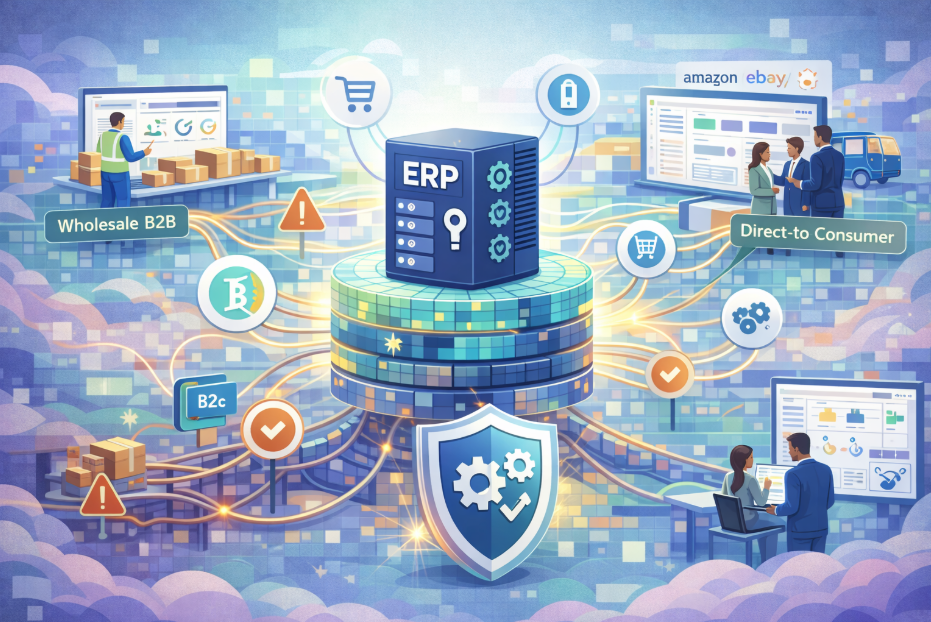
Growth Introduces Constant Change
Modern wholesale and retail businesses rarely stand still.
They add:
- New ecommerce channels
- Marketplaces
- Customer experience tools
- Operational software
- Reporting platforms
- Automation initiatives
Each addition promises commercial benefit. Each also introduces change into the system landscape.
Managing that change — without destabilising core operations — becomes the central challenge.
ERP as the Anchor of Continuity
Enterprise Resource Planning (ERP) systems typically hold the most critical operational data:
- Inventory and availability
- Pricing structures
- Customer records
- Orders and fulfilment history
- Financial transactions
Because these elements underpin day-to-day operations, ERP provides continuity as other systems evolve.
It acts as the stable core around which the business can expand.
Why Instability at the Core Is So Disruptive
When ERP itself is repeatedly reshaped to accommodate new initiatives, unintended consequences multiply.
Changes to core logic can affect:
- Stock accuracy across channels
- Pricing consistency
- Billing and invoicing processes
- Reporting reliability
- Compliance and audit trails
Even small modifications can ripple through interconnected workflows.
This is why ERP changes often require careful planning, testing, and coordination.
The Pressure to Adapt ERP to New Channels
New digital initiatives frequently introduce requirements that do not align perfectly with existing ERP structures.
Examples include:
- Consumer-style promotions
- Marketplace-specific data fields
- Alternative fulfilment models
- Rapid pricing updates
- New customer segmentation approaches
The temptation is to modify ERP to accommodate each new scenario.
Over time, this can erode the system's coherence and increase maintenance complexity.
System of Record vs. System of Experimentation
A useful distinction is between systems of record and systems of experimentation.
Systems of record (like ERP) prioritise:
- Accuracy
- Consistency
- Traceability
- Reliability
Customer-facing systems often prioritise:
- Flexibility
- Speed of change
- User experience
- Market responsiveness
Sustainable architecture allows experimentation at the edges while preserving stability at the core.
Integration as the Mechanism for Stability
Maintaining ERP stability does not mean preventing innovation.
It means managing how new systems interact with ERP.
Structured integration can:
- Translate data between models
- Enforce validation rules
- Synchronise information reliably
- Shield ERP from volatile external behaviour
This allows channels and tools to evolve without forcing structural changes into the core system.
Benefits of Keeping ERP Central
Organisations that maintain ERP as the authoritative system of record often experience:
- Consistent data across channels
- Predictable operational workflows
- Reduced reconciliation effort
- Easier compliance and reporting
- Greater confidence in decision-making
These advantages compound as the business grows.
Sustainable Growth Requires a Stable Core
Expansion is not just about adding revenue streams.
It is about ensuring the organisation can support them operationally over time.
When ERP remains stable:
- Teams trust system outputs
- Processes remain coherent
- Integration patterns become repeatable
- New initiatives can build on existing foundations
Without that stability, growth can introduce fragmentation instead of progress.
Balancing Innovation and Continuity
Successful digital transformation does not freeze core systems indefinitely, but it treats changes to them as significant events rather than routine adjustments.
This balance allows organisations to:
- Innovate rapidly in customer-facing areas
- Preserve operational integrity
- Manage risk proactively
- Maintain long-term scalability
Continuity and innovation become complementary rather than conflicting objectives.
Conclusion
As businesses evolve, the volume of change across channels, tools, and processes increases continuously.
ERP provides the continuity that keeps operations coherent amid that change.
Growth becomes more sustainable when ERP remains the system of record — stable, authoritative, and protected — rather than being reshaped around every new initiative.
In complex wholesale and retail environments, stability at the core is what makes expansion at the edges possible.
This is the approach behind our Brightpearl integration hub: the ERP stays authoritative while channels are added, changed or retired around it.