
The Reality Most Businesses Already Know
Few organisations would describe their ERP system as elegant.
Interfaces can feel dated. Workflows may reflect years of incremental change. Reporting might require workarounds.
Yet despite these imperfections, ERP remains the most authoritative system in the business.
It is where operational truth already resides.
What "Authoritative" Really Means
Authoritative does not mean flawless. It means trusted as the source of record.
Within established wholesale and retail businesses, ERP typically governs:
- Inventory levels and availability
- Pricing structures and rules
- Customer accounts and terms
- Order histories
- Financial transactions
These elements are not just data points. They underpin day-to-day operations and long-term decision-making.
Replacing or bypassing them casually introduces risk.
Why New Channels Create Inconsistencies So Quickly
As businesses expand into additional channels — B2B ecommerce, D2C, marketplaces, sales tools — pressure grows to move data across systems.
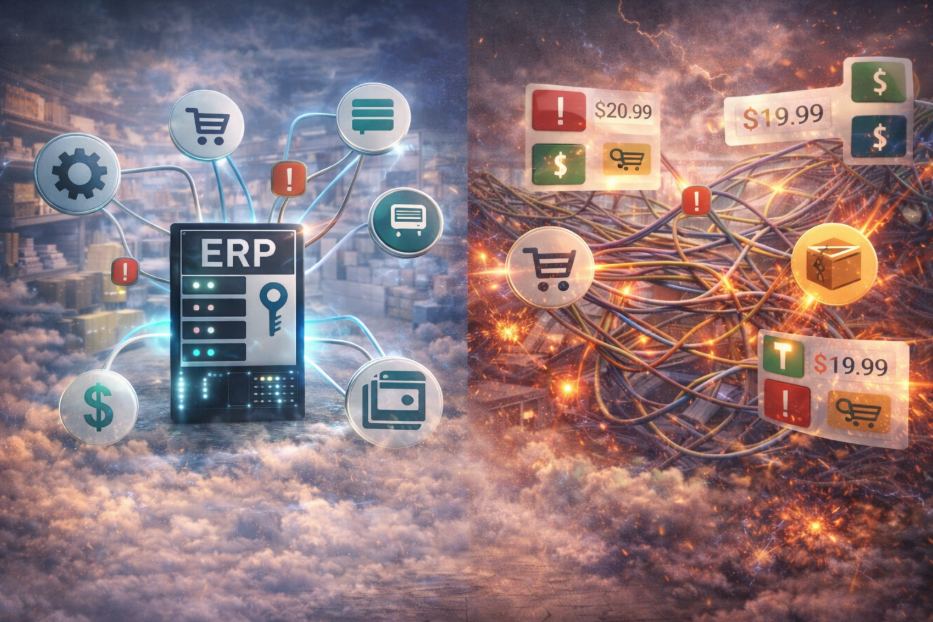
When those channels operate without respecting ERP authority, inconsistencies appear almost immediately:
- Stock levels diverge between platforms
- Pricing differs by channel unintentionally
- Customer records fragment
- Financial reconciliation becomes more complex
These issues often begin as small discrepancies but can escalate as transaction volume increases.
Stock is where this shows up first, and where wholesale differs most sharply from retail. We have set out the practical version — one authoritative figure, channels that subscribe rather than compute, and what to do about back orders — in multichannel inventory management for wholesalers.
The Problem Is Not Technology Preference
ERP-first thinking is sometimes misunderstood as loyalty to a particular system.
In reality, it reflects a governance decision.
ERP-first architecture acknowledges that:
- The business already depends on ERP data integrity
- Operational processes are built around it
- Financial accuracy originates there
- Changing its role carries significant risk
Choosing to keep ERP central is less about preference and more about protecting continuity.
Operational Control vs. System Convenience
Modern digital tools often prioritise speed and user experience.
While valuable, these advantages can create tension if they operate independently from core operational systems.
For example:
- A channel may allow flexible pricing not aligned with ERP rules
- Inventory may be displayed based on local calculations
- Orders may follow workflows incompatible with accounting processes
Without coordination, convenience at the channel level can create complexity at the operational level.
ERP-First Thinking as a Stability Strategy
ERP-first architecture ensures that new systems extend existing operations rather than fragment them.
This typically involves:
- Treating ERP as the system of record
- Designing integrations that synchronise rather than override
- Centralising critical business logic
- Managing change through controlled interfaces
The objective is to allow innovation at the edges while maintaining stability at the core.
Why This Matters as Businesses Evolve
Growth introduces variability:
- New sales channels
- New customer expectations
- New operational tools
- Increased transaction volumes
Without a stable centre, this variability can overwhelm internal processes.
ERP-first thinking provides that centre, allowing the business to evolve without losing coherence.
Imperfect Systems Can Still Be Strategic Assets
Attempting to replace or bypass ERP because it is not ideal often underestimates the complexity embedded within it.
Years of business rules, customer relationships, pricing agreements, and accounting structures accumulate in ERP systems.
Even when imperfect, they represent institutional knowledge encoded in software.
Respecting that knowledge reduces the likelihood of costly disruption.
Conclusion
ERP systems may not be modern, intuitive, or flawless — but they are authoritative.
They hold the data that defines how the business actually operates.
ERP-first thinking is therefore not a technological preference. It is a strategy for maintaining operational control as new channels, tools, and opportunities emerge.
By keeping ERP central, businesses can evolve digitally without sacrificing consistency, accuracy, or stability.
For what this looks like in practice with SAP B1, see our approach to SAP Business One ecommerce integration — trade ordering, D2C and marketplaces without risking the ERP.