
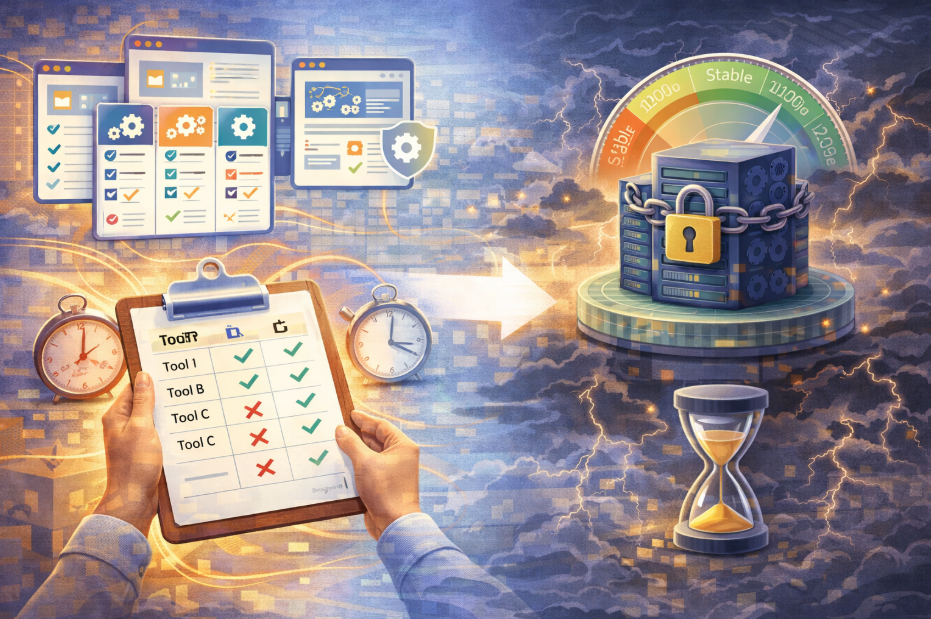
Why Features Are So Easy to Compare
When evaluating ecommerce platforms or integration solutions, feature lists are often the first point of comparison.
They are clear, tangible, and easy to present:
- Does the platform support a specific checkout flow?
- Can it handle promotions or pricing rules?
- Does it integrate with certain tools?
- What add-ons or extensions are available?
Feature comparisons create a sense of clarity during decision-making.
But they only represent part of the picture.
What Feature Lists Don't Show
Feature lists describe what a system can do.
They rarely show:
- How the system behaves under load
- How it handles edge cases and exceptions
- How it integrates with ERP and core systems
- How stable it remains as complexity increases
- How easy it is to maintain over time
These factors only become visible once the system is in use — often after critical decisions have been made.
The Risk of Feature-Led Decision Making
When decisions are driven primarily by features, organisations may select platforms that appear capable in theory but introduce operational challenges in practice.
Common outcomes include:
- Features that work in isolation but conflict with existing processes
- Integration gaps that require workarounds
- Increased dependency on third-party extensions
- Difficulty maintaining consistency across systems
- Unexpected behaviour under real-world conditions
These issues are rarely visible during initial evaluation.
Why Operational Stability Is Harder to Assess
Operational stability is less visible than features because it emerges over time.
It depends on:
- Integration architecture
- Data consistency across systems
- Alignment with ERP processes
- Handling of exceptions and edge cases
- Quality of implementation and governance
Unlike features, stability cannot be easily summarised in a checklist.
Yet it determines whether systems remain reliable as the business grows.
How Systems Behave Under Pressure
The true test of any ecommerce or integration platform occurs under operational pressure:
- High order volumes
- Stock fluctuations
- Pricing updates
- Multi-channel synchronisation
- Customer service demands
Systems designed primarily around feature breadth may struggle to maintain consistency under these conditions.
Durable systems prioritise predictable behaviour, even when complexity increases.
ERP Alignment as a Stability Indicator
For wholesale and retail businesses, alignment with ERP systems is a key factor in long-term stability.
ERP governs:
- Inventory accuracy
- Pricing structures
- Customer data
- Financial processes
Platforms that respect ERP as the system of record are more likely to maintain consistency across channels.
Those that operate independently often introduce discrepancies that require manual correction.
Durability vs. Novelty
New features and innovations can be attractive, particularly when they promise competitive advantage.
However, novelty does not guarantee durability.
Durability reflects:
- Consistent performance over time
- Predictable behaviour across scenarios
- Ease of maintaining and extending the system
- Reduced need for workarounds
In operational environments, durability often provides more long-term value than access to the latest features.
This distinction between durability and novelty is also central to why swapping platforms rarely solves problems on its own — see Replatforming Isn't Transformation for how the same underlying operational issues tend to resurface on a new system when they were not the reason for switching. Where the feature being compared is the integration itself, the cheaper quote often defers cost rather than removing it.
Reframing the Evaluation Process
A more balanced approach to evaluating systems includes questions such as:
- How does this integrate with existing ERP processes?
- What happens when data conflicts occur?
- How are exceptions handled?
- How will this scale with additional channels?
- What operational responsibilities does this introduce?
These questions shift focus from feature comparison to system behaviour.
Buyers themselves increasingly agree with this reframing. Demandbase's State of the B2B Buyer research reports that 89% of buyers prioritise integration capabilities over standalone features. That reflects a broader shift away from feature-by-feature comparison and toward exactly the questions above: how a system behaves inside an existing operational environment, rather than what it can do in isolation.
Why Experienced Operators Prioritise Stability
Organisations with prior experience of system failures or integration challenges tend to place greater emphasis on stability.
They recognise that:
- Features can be added or extended over time
- Operational disruption is costly and difficult to reverse
- Consistency and reliability underpin long-term growth
This perspective often leads to more conservative but more sustainable technology decisions.
Conclusion
Feature lists are useful for understanding capabilities, but they do not capture how systems perform in real-world conditions.
Commercial decisions based solely on features risk overlooking the importance of operational stability.
In ERP-driven wholesale and retail environments, durability — consistent, predictable system behaviour over time — is often more valuable than novelty.
Choosing systems that prioritise stability alongside functionality supports sustainable growth and reduces long-term operational risk.
Feature Chasing in eCommerce: Common Questions
Why is choosing a platform based on features alone risky?
Feature lists show what a system can do, not how it behaves under real operational pressure — high order volumes, exceptions, multi-channel sync and ERP alignment. Those conditions determine whether a platform holds up in practice, and they are largely invisible in a comparison table. The gap usually appears after implementation, which is also when it is most expensive to act on.
Do B2B buyers actually prioritise integration over features?
Increasingly, yes. Demandbase's State of the B2B Buyer research reports that 89% of buyers prioritise integration capabilities over standalone features when evaluating a platform.
What should replace feature comparison in the evaluation process?
Questions about system behaviour: how the platform integrates with existing ERP processes, how it handles data conflicts and exceptions, and how it scales with additional channels — rather than a checklist of what it can technically do.
Does this mean new features don't matter?
Not at all. Features can be added over time. What matters more for long-term risk is whether the underlying system is stable and consistent — durability tends to provide more value than novelty in operational environments.
This is the approach behind our Brightpearl integration hub: the ERP stays authoritative while channels are added, changed or retired around it.