
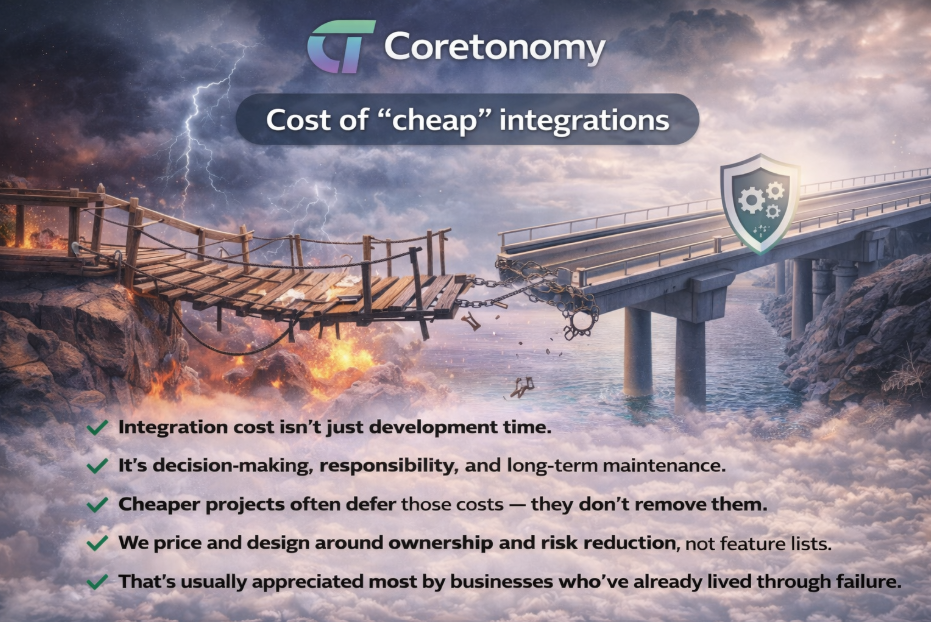
Integration Cost Is Rarely What It Appears to Be
When wholesale and retail businesses evaluate digital commerce or system integration projects, the first comparison is often price.
Quotes are reviewed. Development hours are compared. Feature lists are assessed.
But integration cost is not simply the cost of building connections between systems.
It includes:
- Architectural decision-making
- Operational responsibility
- Long-term maintenance
- Risk management
- Data integrity assurance
When these factors are excluded from pricing, they do not disappear. They simply reappear later.
Why "Cheap" Integrations Can Become Expensive
Lower-cost integration projects often optimise for short-term delivery rather than long-term stability.
This typically involves:
- Minimal architectural planning
- Limited responsibility for operational outcomes
- Basic data handling approaches
- Deferred governance decisions
- Undefined ownership for future changes
Initially, the project appears cost-effective.
Over time, hidden costs emerge through:
- Rework when systems evolve
- Data inconsistencies between platforms
- Manual operational workarounds
- Integration rebuilds
- Increased dependency on specific developers
The original savings are often offset by ongoing operational friction.
This pattern is not specific to integration work — it is what cost-of-ownership research has measured for decades. The long-standing finding, from Gartner TCO research documented in Communications of the ACM, is that initial acquisition accounts for only about 20% of a system's total cost of ownership, with the remaining 80% falling to administration, operation and change across its working life (David, Schuff and St. Louis, "Managing Your Total IT Cost of Ownership", Communications of the ACM 45(1), 2002). More recently, McKinsey's survey of CIOs put technical debt — the accumulated cost of shortcuts taken to ship faster — at 20–40% of the value of their entire technology estate before depreciation, and found 10–20% of the budget earmarked for new products was being diverted into resolving it instead (McKinsey, Tech debt: Reclaiming tech equity).
Neither figure is about integration quotes specifically, and the 20/80 split is directional rather than a precise law. But the direction is the point, and it is ours to draw: a cheap integration quote prices the build, and the build is the smaller share of what the system will cost you. The rest does not disappear because it was left off the quote. It resurfaces as rework, manual workarounds, and eventually a rebuild.
The Costs That Are Often Deferred
When integration work is priced narrowly around development time, several critical responsibilities may be left unresolved.
Architectural Decisions
How should systems communicate? Where should business logic reside? How will data be validated?
If these decisions are not fully addressed upfront, they become future problems.
Operational Ownership
Who is responsible when stock data is incorrect? Who resolves pricing discrepancies? Who manages system behaviour during change?
Without defined ownership, issues persist longer and impact operations more severely.
Long-Term Maintenance
Systems change. Channels evolve. Business requirements grow.
Integrations must adapt over time, and that maintenance requires structured design from the outset.
Integration Is an Operational Commitment
In ERP-centric wholesale environments, integration is not a technical add-on.
It directly affects:
- Order processing
- Pricing accuracy
- Inventory management
- Customer relationships
- Financial reporting
This makes integration an operational commitment, not just a development project.
The real cost reflects the responsibility taken for protecting these processes.
We've written separately about why this makes ownership the deciding factor on ERP-linked projects — see Integration Ownership: The Governance Factor Behind Successful ERP Projects.
Pricing Around Risk Reduction, Not Features
Some integration providers compete primarily on feature lists or development speed.
Coretonomy's approach is different.
Integration work is priced and designed around:
- Clear ownership of outcomes
- Structured decision-making
- Repeatable architectural patterns
- Long-term operational stability
- Reduction of integration risk
This approach prioritises system reliability over rapid delivery of isolated functionality.
Why Experience Changes How Businesses Evaluate Cost
Businesses that have previously experienced integration failures often evaluate projects differently.
They have seen the consequences of:
- Poor data synchronisation
- System instability
- Operational disruption
- Unexpected maintenance costs
For these organisations, the value of controlled architecture and clear accountability becomes more apparent.
Price alone is no longer the primary metric. Predictability and reliability become equally important.
It is also why integration decisions made purely on price tend to resurface as bigger problems later — see Why Integration Decisions Based Only on Price Often Lead to Higher Costs for the mechanics of how that plays out.
The Relationship Between Ownership and Cost
Integration pricing reflects the level of responsibility assumed.
Lower-cost projects may transfer risk to the client organisation through:
- Limited support boundaries
- Undefined operational responsibility
- Minimal long-term accountability
More structured integration approaches assume greater responsibility for system behaviour and outcomes.
That difference explains variation in pricing models.
Long-Term Value vs. Short-Term Savings
The central question is not whether a project is inexpensive at launch.
It is whether the integration remains stable, predictable, and maintainable as the business grows.
Short-term savings can introduce long-term operational cost if architecture lacks structure and ownership.
Long-term value comes from reducing disruption, rework, and uncertainty.
Conclusion
The cost of integration extends beyond development effort.
It includes responsibility, decision-making, and ongoing system reliability.
Lower-cost projects often defer these costs rather than eliminate them.
For ERP-centric wholesale businesses — where operational disruption is expensive — integration design that prioritises ownership and risk reduction provides greater long-term stability.
This post is about why cheap quotes mislead. For the costs themselves — what ERP integration involves, the four ways it gets built and what each one realistically costs — we set the numbers out plainly rather than leaving them to a quote.
If Brightpearl is your operational backbone, see how the Brightpearl integration hub keeps it the system of record while B2B, D2C and marketplace channels change around it.
The Real Cost of Cheap Integrations: Common Questions
Why do cheap integration quotes end up costing more overall?
Because the quote covers the build, and the build is the smaller part of the bill. Long-standing cost-of-ownership research puts initial acquisition at roughly 20% of a system's total cost over its working life, with the rest going to administration, operation and change. A quote priced only around development time leaves that larger share unpriced and unscheduled — and it reappears later as rework, manual workarounds, or a rebuild.
What is "technical debt" in the context of an ERP integration?
It is the accumulated cost of shortcuts taken to deliver faster at the outset — thin architecture, undefined ownership, minimal error handling. McKinsey's CIO survey put technical debt at 20–40% of the value of an organisation's entire technology estate, and found 10–20% of the budget meant for new products was being diverted to deal with it. On an integration it usually surfaces first as reconciliation work nobody scheduled.
How does Coretonomy's pricing differ from a typical cheap integration quote?
Pricing is built around ownership of outcomes, structured decision-making and long-term operational stability rather than development hours or a feature checklist. The practical difference is that responsibility for what happens after go-live is priced in from the start rather than deferred to whoever is holding the system when it breaks.
Is a lower-cost integration ever the right choice?
Yes — for narrow, well-contained connections where the operational stakes are low and change is unlikely. A one-off feed with a stable contract and a clear owner is perfectly reasonable. The risk profile changes once ERP data, pricing or multi-channel order flows are involved, because that is where deferred costs resurface hardest.