
Integration Architecture Is a Business Decision
When organisations discuss system integration, the conversation often centres on technology — platforms, APIs, middleware, or tooling.
But the more consequential question is architectural:
Who controls how data moves across the business?
Integration design determines whether change introduces risk or remains contained.
What an Integration Hub Actually Does
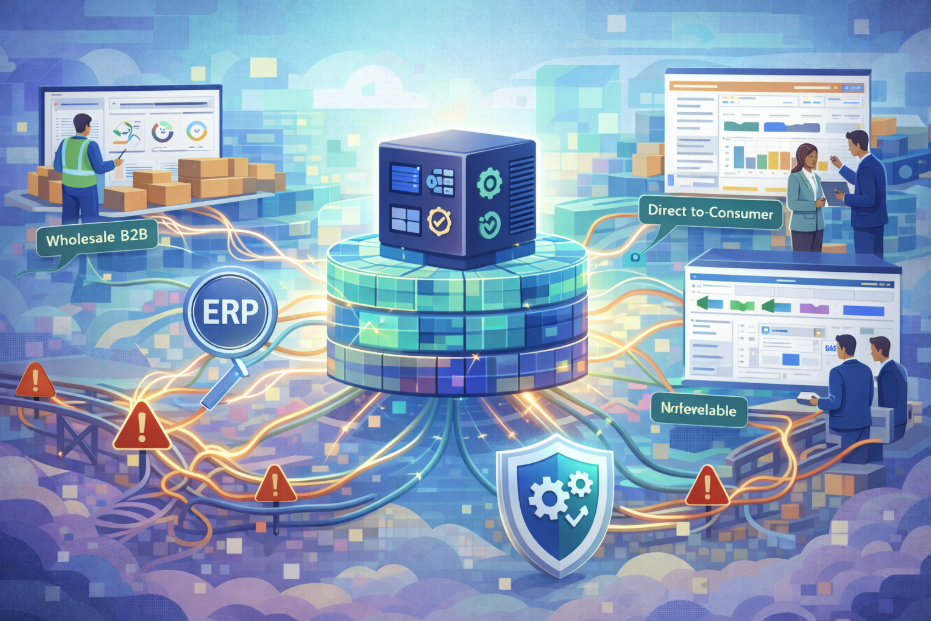
An integration hub creates a structured intermediary layer between core systems — typically ERP — and external channels such as ecommerce platforms, marketplaces, or operational tools.
Instead of systems connecting directly to each other, they connect through this central layer.
Key functions typically include:
- Data transformation and mapping
- Business rule enforcement
- Message routing
- Monitoring and logging
- Error handling
The hub becomes the controlled gateway through which information flows.
Why Point-to-Point Connections Become Fragile
Without a hub, integrations often evolve organically:
- ERP connects directly to ecommerce
- Ecommerce connects to marketplaces
- Reporting tools extract data independently
- Operational systems build their own connections
Each link introduces dependency. As the network grows, understanding the impact of change becomes increasingly difficult.
A modification in one system can trigger unintended consequences elsewhere because connections are interwoven.
Stability at the Core, Flexibility at the Edge
ERP systems typically serve as the system of record for:
- Inventory
- Pricing
- Customers
- Orders
- Financial data
These functions require stability.
At the same time, customer-facing channels — websites, apps, marketplaces — evolve rapidly.
An integration hub allows both realities to coexist:
- ERP remains stable and authoritative
- Channels can change, be added, or removed
- Data consistency is maintained across the ecosystem
This separation protects core operations from external volatility.
Decision Control vs. Technical Elegance
Integration hubs are sometimes perceived as technically sophisticated or complex solutions.
However, their primary value is governance, not elegance.
Centralising data flows enables organisations to:
- Define where business logic resides
- Control how data is validated
- Standardise integration patterns
- Manage changes in a predictable way
The architecture becomes a mechanism for decision control rather than a display of technical capability.
Reducing Risk Through Centralisation
Risk in multi-system environments arises from uncertainty:
- Unclear dependencies
- Inconsistent data handling
- Limited visibility into system interactions
- Difficulty diagnosing issues
A hub reduces these uncertainties by consolidating integration logic and providing a single point of oversight.
This makes it easier to assess impact before implementing changes and to resolve problems when they occur.
Supporting Long-Term Growth
As businesses expand, integration requirements rarely remain static.
New channels, partners, and tools must be incorporated over time.
With a hub in place:
- New integrations follow established patterns
- Existing connections remain undisturbed
- Scaling becomes repeatable rather than experimental
- Operational teams gain confidence in system behaviour
Growth becomes an architectural extension rather than a disruptive event.
Why Control Is the Real Advantage
Technology choices will evolve. Platforms will be replaced. Business models will shift.
Control over data movement and system interaction provides continuity amid these changes.
Organisations that maintain this control can adapt without destabilising their operations, while those with fragmented integrations may struggle to implement even minor updates safely.
Conclusion
An integration hub is not primarily about technological sophistication.
It is about maintaining decision control in a complex, multi-channel environment.
By replacing fragile point-to-point connections with a structured data layer, businesses can keep ERP systems stable while allowing customer-facing channels to evolve.
Control reduces uncertainty.
Reduced uncertainty lowers operational risk.
And lower risk enables sustainable growth.
This is the approach behind our Brightpearl integration hub: the ERP stays authoritative while channels are added, changed or retired around it.