
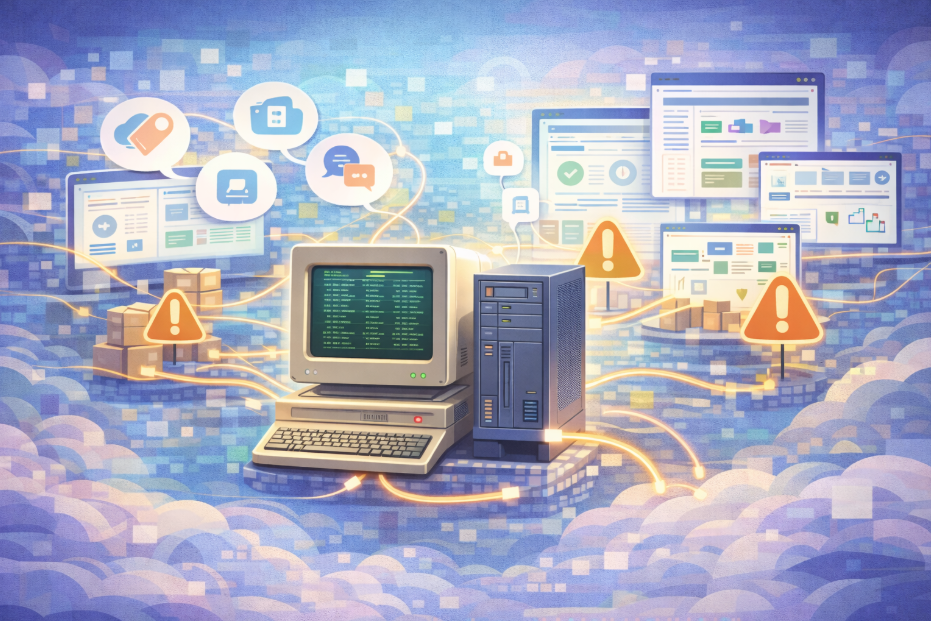
Why Legacy Systems Still Exist
Many established wholesale and retail businesses operate with systems that would be described as "legacy."
These systems may have:
- Older user interfaces
- Limited modern integrations
- Architecture built before cloud computing became standard
Yet despite these characteristics, they often remain central to daily operations.
The reason is simple: they work.
They process orders, maintain customer records, track inventory, and support financial reporting reliably.
Legacy Systems Often Contain Institutional Knowledge
Over years — sometimes decades — operational systems accumulate embedded knowledge about how a business functions.
This knowledge can include:
- Product hierarchies and catalog structures
- Customer-specific pricing rules
- Order processing workflows
- Supplier relationships
- Financial accounting practices
Even if the system appears technically outdated, it may encode complex operational logic that is difficult to reproduce quickly elsewhere.
Replacing such systems without fully understanding this knowledge introduces risk.
Why Replacement Projects Are Risky
System replacement initiatives are frequently motivated by visible shortcomings:
- Outdated interfaces
- Limited reporting capabilities
- Difficulty connecting to new tools
- Vendor support concerns
However, large-scale replacement projects must replicate not only functionality but also operational nuance.
If these nuances are missed, organisations may encounter:
- Data inconsistencies
- Workflow disruption
- Loss of historical business logic
- Training challenges for staff
- Temporary declines in operational efficiency
The impact often extends beyond IT teams into finance, logistics, and customer service.
Integration as an Alternative Strategy
Instead of replacing legacy systems immediately, many organisations choose to integrate them with newer technologies.
Integration allows businesses to:
- Preserve operational stability
- Introduce modern customer-facing tools
- Extend data visibility
- Connect additional sales channels
- Automate manual processes
This approach treats the legacy system as a stable operational core rather than a problem to eliminate.
Respecting the Stability Already in Place
Legacy systems typically persist because they have proven reliable in real-world conditions.
They have already survived:
- Market fluctuations
- Product expansions
- Staff turnover
- Process evolution
This history indicates a degree of operational resilience.
Integration strategies that respect this stability reduce the likelihood of unintended disruption.
Gradual Modernisation vs. Sudden Replacement
A gradual approach to modernisation allows organisations to evolve systems over time rather than through a single large transformation.
Benefits include:
- Lower operational risk
- More manageable change for teams
- Better understanding of system dependencies
- Opportunities to validate improvements incrementally
This phased model often results in more predictable outcomes than immediate replacement.
When Replacement May Still Be Necessary
There are situations where replacing legacy systems becomes unavoidable, particularly when:
- Vendor support has ended
- Security vulnerabilities cannot be mitigated
- System performance limits growth
- Integration becomes technically impossible
Even in these cases, careful planning and staged migration are essential to avoid operational disruption.
Aligning Technology Decisions With Operational Reality
Technology strategies should reflect the operational realities of the business.
For ERP-driven wholesale organisations, stability and continuity often outweigh aesthetic improvements or short-term convenience.
Respecting existing systems — and integrating them thoughtfully — ensures that modernisation supports the business rather than destabilising it.
Conclusion
Legacy systems persist not because organisations resist change, but because those systems often contain the operational knowledge that keeps the business running.
Replacing them carelessly can introduce significant risk.
In many cases, integration that respects existing stability provides a more effective path forward than wholesale replacement.
By modernising around stable operational cores, businesses can evolve technologically without compromising the processes that already work.
For what this looks like in practice with SAP B1, see our approach to SAP Business One ecommerce integration — trade ordering, D2C and marketplaces without risking the ERP.