
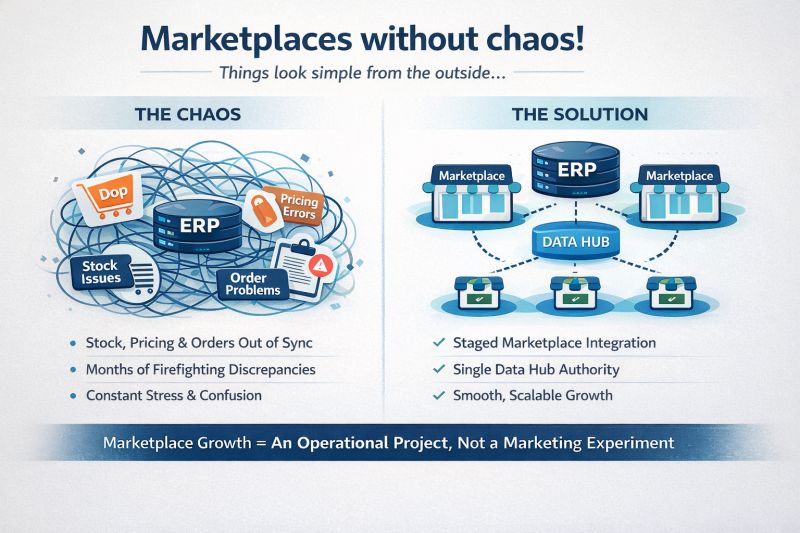
Marketplaces Look Simple — Until Operations Feel the Strain
From the outside, selling on marketplaces appears straightforward.
Listings go live. Orders come in. Revenue grows.
But inside established wholesale and retail businesses, the complexity surfaces quickly — not in marketing, but in operations.
The problems rarely start with the marketplace itself. They start when marketplace activity drifts away from ERP reality.
Where Marketplace Projects Begin to Break Down
Marketplaces introduce an additional sales channel into an environment where systems already exist to manage:
- Stock levels
- Pricing structures
- Customer agreements
- Order processing
- Financial reporting
When marketplaces are added as a bolt-on, the integration between channel activity and ERP is often minimal at launch.
At first, this seems manageable.
Then discrepancies begin to appear.
The scale of this is well documented beyond any single business. IHL Group, which has tracked the measure for eight consecutive years, puts the global retail cost of inventory distortion — out-of-stocks plus overstocks — at roughly $1.77 trillion a year, and attributes close to $500 billion of that to retailers' own internal inefficiency rather than to theft, supplier failure or supply chain disruption (IHL Group research findings).
Inventory software vendor Cin7 publishes a narrower figure pointing the same way: inventory accuracy as low as 63% on disconnected systems, against 95% and above where tracking is centralised and automated (Cin7: multichannel inventory management challenges). Cin7 credits unnamed industry benchmarks for those numbers rather than a published study, so they are best read as indicative.
Neither figure is a UK wholesale number, and no individual business will recognise itself in a trillion-dollar total. Our own conclusion from them is narrower: the internal-inefficiency share is the part a business actually controls, and systems disagreeing about stock and price is how it accumulates. That is the failure marketplace integration exists to prevent. The wholesale-specific version of that argument — why the same item honestly has four different stock numbers, and which of them a channel is allowed to see — is in our piece on multichannel inventory management for wholesalers.
The exposure is also growing rather than shrinking. Faire's UK independent retail network now spans 15,000 locations after five years in the market, and the number of orders each brand receives has grown by more than 120% since 2022 (Faire UK, via InsightDIY). The marketplace side of a wholesale business can now scale faster than an unintegrated back office keeps pace with.
The Common Symptoms of Marketplace Chaos
Businesses often describe the same early signs:
- Stock showing as available on marketplaces when ERP shows otherwise
- Pricing inconsistencies between channels
- Orders requiring manual correction
- Finance teams reconciling unexpected differences
- Customer service dealing with avoidable issues
Individually, these seem minor. Collectively, they create operational drag.
Marketplace growth, instead of being a source of scale, becomes a source of internal friction.
Why "Bolt-On" Marketplace Approaches Create Risk
Marketplace launches are frequently treated as commercial initiatives rather than operational ones.
The focus is placed on:
- Speed to list products
- Channel visibility
- Marketing opportunity
But without structured integration, data begins to flow in fragmented ways:
- Point-to-point connectors
- Manual exports and imports
- Custom scripts built quickly to fill gaps
This creates a system landscape where marketplaces are technically live, but operationally unstable.
ERP is no longer the clear system of record. Instead, truth becomes distributed across systems.
That ambiguity is where firefighting begins.
This is the same fragility described in Point-to-Point vs Integration Hub: Why Direct ERP Connections Break — each new marketplace connector added the same way compounds the risk rather than spreading it out safely.
Marketplace Growth Is an Operational Project
A more stable approach starts from a different assumption:
Marketplace expansion is an operational change before it is a marketing one.
That shift reframes the project:
- ERP remains the authoritative source of stock and pricing
- Order data flows back consistently
- Integration is designed before scale is introduced
- Channel rollout is staged, not rushed
Instead of launching everything at once, the business validates data flows and processes in controlled steps.
This reduces the likelihood of discrepancies multiplying as volume grows.
It's the same principle covered from the readiness angle in Marketplaces and Wholesale Operations — Why Stability Matters Before Expansion: the underlying ERP and process foundation needs to be stable before a new channel is layered on top of it.
The Role of a Single Integration Data Hub
As channels increase, point-to-point integration models become fragile.
Each new marketplace adds another connection, another potential failure point, and another place where data may diverge.
A centralised integration architecture changes this dynamic.
Through a single data hub:
- ERP communicates through one structured integration layer
- Channels connect to that layer, not directly to ERP
- Data transformations are managed in one place
- Expansion becomes repeatable rather than improvised
This structure does not eliminate complexity. It contains it.
That containment is what keeps operations stable as marketplaces scale.
Staged Integration Reduces Firefighting
When marketplace integration is staged:
- Core data flows are validated
- Stock synchronisation is proven reliable
- Pricing logic is confirmed
- Order return paths are tested
- Exception handling is understood
Only then does scale increase.
This approach may appear more deliberate at the start, but it avoids the prolonged clean-up phase that follows rushed implementations.
This is also why sequencing matters across every channel, not just marketplaces — see Channel Sequencing: Why Expanding Every Sales Channel at Once Creates Risk for the wider principle.
Growth Should Not Increase Operational Stress
Marketplace expansion should improve commercial reach, not introduce new operational uncertainty.
When discrepancies become routine, internal confidence in systems declines. Teams begin creating manual workarounds, and the business slowly moves further from structured control.
The objective of integration is not just technical connectivity.
It is preserving operational clarity while channels multiply.
Conclusion
Marketplaces are powerful growth channels. But without structured integration, they can introduce more complexity than capacity.
The difference lies in how the project is framed:
- As a marketing experiment, or
- As an operational integration programme
When ERP remains authoritative and integration is staged through a central data architecture, marketplace growth can scale without destabilising the business.
That is what turns marketplaces from a source of chaos into a controlled extension of operations.
Marketplace ERP Integration: Common Questions
Why do marketplace listings drift out of sync with ERP stock and pricing?
Most drift starts when a marketplace is connected directly to individual systems rather than through one integration layer. Each connection updates on its own schedule, so stock and pricing can disagree between the ERP, the marketplace and any other connected channel — especially under batch sync delays rather than real-time updates.
What is a marketplace integration data hub?
It's a single integration layer that sits between the ERP and every marketplace or channel, rather than connecting each channel directly to the ERP. The ERP communicates through one structured layer, transformations are managed in one place, and adding a new marketplace becomes a repeatable process rather than a one-off custom build.
Is it safe to launch on Amazon, eBay and Faire at the same time?
Launching every marketplace simultaneously multiplies the number of untested data flows at once, which is exactly when discrepancies compound fastest. A staged rollout — validating stock sync, pricing logic and order return paths on one channel before adding the next — reduces that risk substantially.
How much does marketplace inventory drift actually cost a wholesale business?
There is no published figure for UK wholesale specifically. The nearest reliable anchor is IHL Group's global retail estimate of roughly $1.77 trillion a year for inventory distortion — out-of-stocks plus overstocks — of which close to $500 billion is attributed to retailers' own internal inefficiency rather than to theft or supplier failure. That internal share is the part integration governs. In an individual business it shows up as oversells, cancellations, marketplace account metrics and hours spent reconciling by hand.