
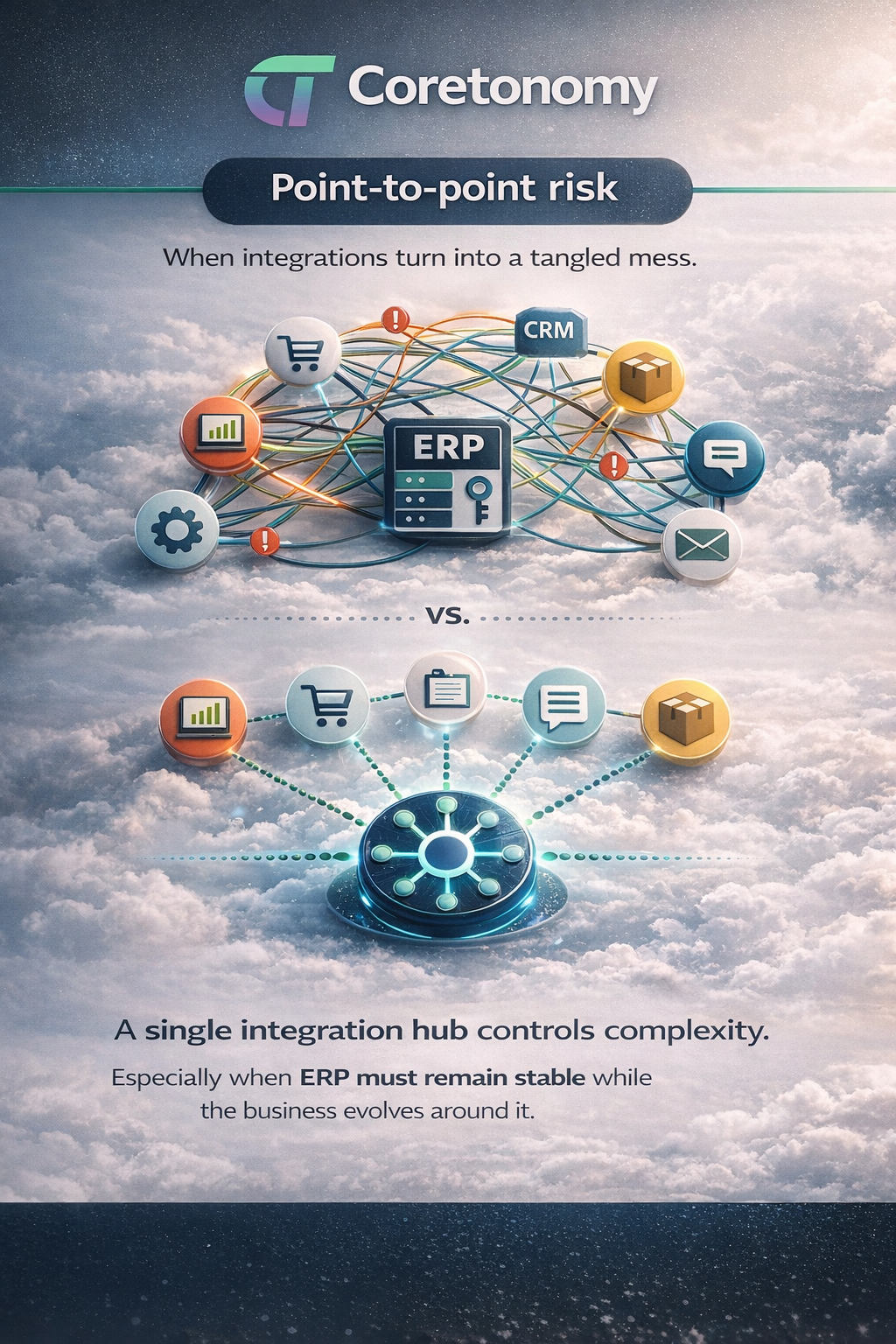
Point-to-Point Integrations Work — Until They Don't
Most established wholesale and retail businesses don't start with an integration strategy.
They start with a requirement.
A new ecommerce platform needs stock. A marketplace needs pricing. A D2C site needs order data in ERP.
So a connection is built between two systems. Then another. Then another.
Individually, each integration works. Collectively, they create structural fragility.
How Integration Sprawl Develops
Point-to-point architecture grows incrementally:
- ERP connects directly to B2B ecommerce
- ERP connects separately to D2C
- Marketplaces connect into ecommerce
- Shipping tools pull from multiple systems
- Reporting tools extract data independently
No single decision appears risky. The issue is cumulative.
Each new connection introduces another dependency path — and another place where change can cause unintended consequences.
The Hidden Cost of "It Works for Now"
Early on, point-to-point integrations appear efficient:
- Fast to implement
- Limited upfront design
- Immediate functional results
The risk emerges later, when change becomes necessary.
At that point, teams begin asking:
- If we update pricing logic, which systems rely on it?
- If we change stock allocation rules, what breaks?
- If we add a new channel, where should integration sit?
When architecture is fragmented, the answers are unclear.
Uncertainty is what makes change expensive.
Why Complexity Increases Exponentially
Each system added to a point-to-point network increases connection paths, not linearly, but multiplicatively.
More paths mean:
- More potential failure points
- More monitoring overhead
- More inconsistent data flows
- More knowledge trapped in individual developers' heads
Over time, the integration landscape becomes something the business depends on — but no one fully understands.
That is where operational risk begins to restrict growth.
The arithmetic is simple enough to do on the back of an envelope. Connecting n systems directly to one another takes up to n(n−1)/2 links: five systems can mean ten connections, ten systems can mean 45, and twenty can mean 190 — each one a separate thing to build, monitor, maintain and eventually fix. McKinsey describes the consequence in its research on technology debt, defining the "complexity tax" every project pays as deriving from "the need to work through fragile point-to-point or batch data integrations, harmonize nonstandard data, and create workarounds to confront risk and meet business needs" (McKinsey, Tech debt: Reclaiming tech equity). For a wholesale business adding one channel at a time, that tax is how "it works for now" quietly turns into a structural liability a few channels later.
The Alternative: A Single Integration Hub
A centralised integration hub changes the structure.
Instead of systems connecting to each other directly, they connect to one controlled layer.
This approach:
- Standardises data transformation
- Centralises business logic
- Makes dependencies visible
- Reduces duplication of integration code
- Creates a controlled point for change
The goal is not technical elegance. It is operational control.
We go into the practical mechanics of that shift in Integration Hubs: Why Control Matters — what actually changes operationally when you move from direct connections to a controlled layer.
For the wider picture — what ERP integration moves between the systems, the four ways it gets built, and what each approach costs — start there and come back to the detail.
This Is About Stability, Not Complexity
An integration hub may appear more deliberate at the outset, but its purpose is to reduce long-term unpredictability.
Especially in ERP-centric businesses.
ERP systems hold:
- Stock truth
- Pricing governance
- Customer agreements
- Financial integrity
If ERP must remain stable while channels evolve, the integration layer must absorb change safely.
Point-to-point structures struggle to do that because change radiates unpredictably across connections.
Why This Matters as Channels Multiply
Wholesale and retail businesses rarely operate through a single channel today.
They combine:
- B2B ecommerce
- D2C sites
- Marketplaces
- Sales agents
- Exhibitions and trade shows
- Operational tools
Each new channel should be an extension, not a destabiliser.
Without an integration hub, every addition increases fragility. With one, each addition follows an established pattern.
That difference determines whether growth creates opportunity — or operational strain.
The Real Advantage: Confidence in Change
The most valuable outcome of an integration hub is not speed.
It is confidence.
When architecture is controlled:
- Teams know where data logic resides
- Changes are made in one place
- Impact can be assessed before deployment
- Risk is reduced
That confidence allows businesses to evolve without fearing that unseen dependencies will cause disruption.
It is also what makes change control possible in the first place — see Change Control in Wholesale eCommerce for how a controlled integration layer turns unpredictable changes into a manageable, auditable process.
Conclusion
Point-to-point integrations are not inherently wrong. They are simply limited in how far they scale safely.
As channels expand, fragility compounds.
A central integration hub is not about adding complexity. It is about containing it.
And for ERP-centric wholesale businesses, containment of integration risk is what keeps growth aligned with operational stability.
For a concrete example of this architecture, see the Brightpearl integration hub — one controlled layer between the ERP and every sales channel.
Point-to-Point vs Integration Hub: Common Questions
Why do point-to-point integrations become riskier as a business grows?
Because the number of possible connection paths grows combinatorially rather than linearly. Connecting n systems directly can require up to n(n−1)/2 links, so twenty systems can mean 190 separate connections — each with its own failure modes, monitoring burden and maintenance cost. The risk is not any single connection; it is that no one can see the whole map any more.
Is a point-to-point integration ever the right choice?
Yes — for a single, well-defined connection between two systems that will not be extended further. A one-off feed with a stable contract and a clear owner is perfectly reasonable. The risk starts with the third, fourth and tenth connection being added without a controlling layer, because that is the point at which each new link starts interacting with the others.
What does an integration hub actually change day to day?
It moves business logic and data transformation out of individual connections and into one controlled layer, so a change is made and tested in one place rather than traced across every connection it might touch. Day to day, that shows up as shorter impact assessments before a change and fewer surprises after one.
Does moving to an integration hub mean rebuilding all our existing connections at once?
No. A hub can be introduced incrementally — absorbing new connections first, then migrating existing ones as capacity allows. That avoids a single disruptive cutover, and it means the architecture improves with each channel added rather than requiring a project of its own.