
The Appeal of Replatforming
When ecommerce or digital systems begin to feel restrictive, replatforming often appears to be the solution.
A new platform promises:
- Improved user experience
- Modern features
- Faster performance
- Better scalability
- Access to new tools and integrations
From a commercial perspective, this can feel like a clear path to progress.
But replatforming, on its own, rarely delivers transformation.
What Replatforming Actually Does
Replatforming is the process of replacing one system with another.
It changes:
- The interface users interact with
- The underlying technology stack
- The available features and integrations
However, it does not automatically change:
- Operational processes
- Data structures
- Integration architecture
- Business rules
- Organisational workflows
These elements determine how the business actually functions.
Why Problems Reappear After Replatforming
Many organisations experience a similar pattern after moving to a new platform:
- Initial improvements in usability
- Short-term gains in efficiency
- Followed by the re-emergence of familiar issues
Common examples include:
- Data inconsistencies between systems
- Manual workarounds persisting
- Integration gaps requiring custom solutions
- Operational friction across departments
This occurs because the underlying causes were never addressed.
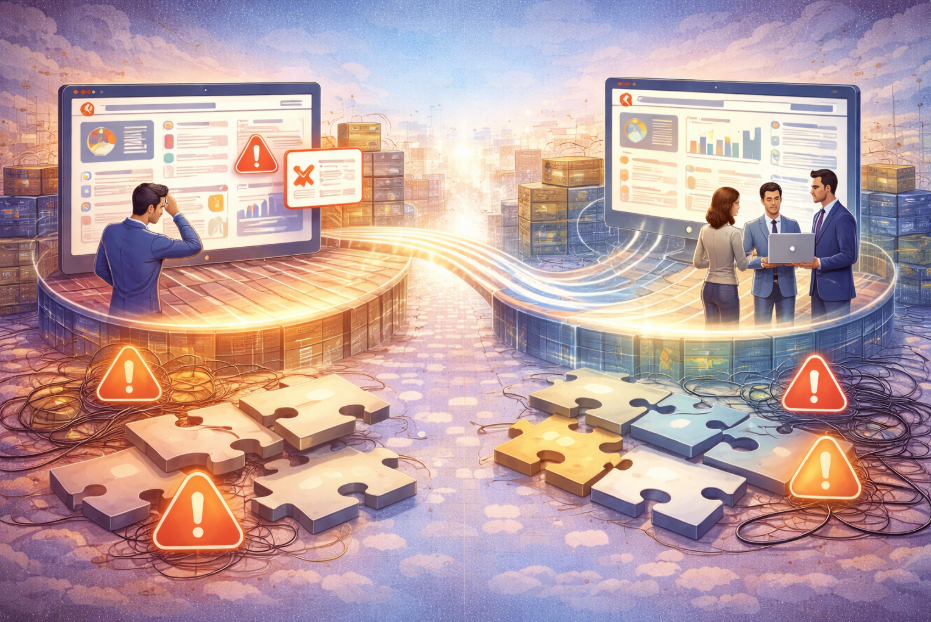
The platform has changed, but the structure around it has not.
Transformation Requires More Than Technology
Digital transformation is often framed as a technology upgrade.
In practice, it involves aligning multiple elements:
- Systems and integrations
- Data governance
- Operational processes
- Team responsibilities
- Decision-making structures
Without this alignment, new technology simply inherits existing inefficiencies.
The Role of Integration Discipline
Integration discipline refers to how systems are connected and how data flows between them.
Key considerations include:
- Where business logic resides
- Which system is the system of record (often ERP)
- How data is validated and synchronised
- How exceptions are handled
- How changes are managed over time
Without structured integration, a new platform may introduce additional complexity rather than reducing it.
ERP Alignment as a Critical Factor
For wholesale and retail businesses, ERP systems typically underpin core operations.
If a new ecommerce platform operates independently from ERP:
- Pricing may diverge
- Stock accuracy may degrade
- Customer data may fragment
- Order processing may require manual intervention
Replatforming without ERP alignment risks recreating the same operational issues in a different environment.
Operational Alignment Is Often Overlooked
Technology changes are visible. Operational changes are less so.
Yet transformation depends on how teams work:
- Are processes standardised?
- Are responsibilities clearly defined?
- Are workflows aligned with system capabilities?
- Are exceptions handled consistently?
If operational practices remain unchanged, system improvements may not translate into business improvements.
Replatforming as a Step, Not the Destination
Replatforming can be a valuable step when:
- Existing systems are no longer supported
- Performance limitations restrict growth
- Integration capabilities are insufficient
- User experience needs improvement
However, it should be treated as part of a broader transformation strategy rather than the final objective.
Avoiding "Same Problems, New Interface"
To prevent repeating existing issues, organisations should evaluate:
- How integration architecture will change
- How ERP will remain central or be affected
- How data consistency will be maintained
- How operational processes will evolve
- How ownership and governance will be structured
Addressing these areas ensures that new platforms deliver meaningful improvement.
Conclusion
Replatforming changes technology, but it does not automatically change how a business operates.
Without integration discipline and operational alignment, new platforms often reproduce the same issues in a different interface.
True transformation requires coordinated changes across systems, processes, and governance — with ERP remaining central to operational stability.
Replatforming can support that journey, but it is only one step.
If Brightpearl is your operational backbone, see how the Brightpearl integration hub keeps it the system of record while B2B, D2C and marketplace channels change around it.