
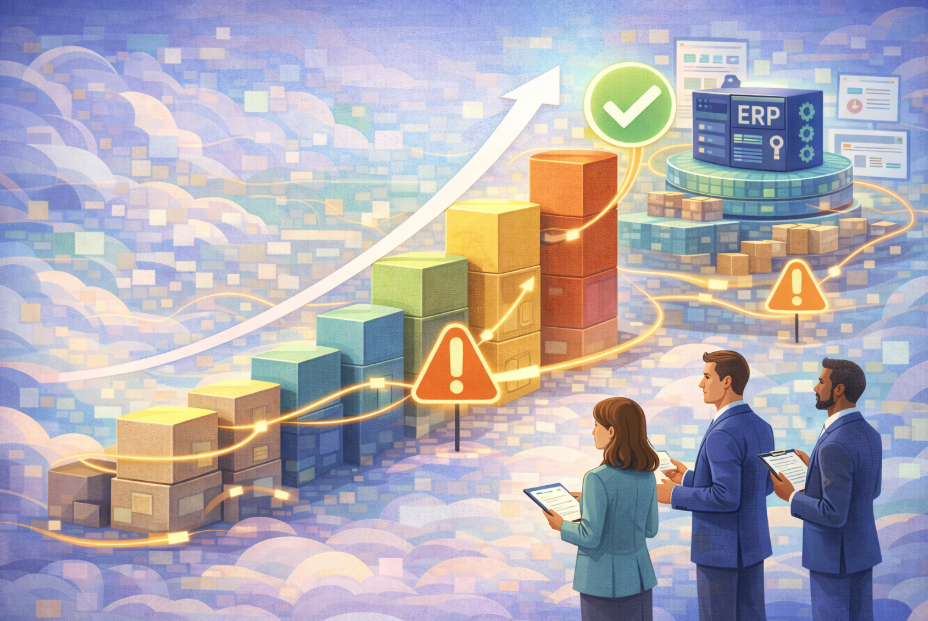
Growth Is Not the Same as Stability
Most businesses aim to grow.
New customers, additional channels, expanded product lines, and increasing order volumes are all positive indicators of commercial success.
However, growth introduces pressure across operational systems:
- Inventory management
- Order processing
- Customer service
- Financial reconciliation
- Supply chain coordination
If these functions cannot scale alongside revenue, operational strain begins to accumulate.
When Growth Creates Operational Strain
Operational strain rarely appears immediately.
Instead, it develops gradually as activity increases.
Common signs include:
- Rising order processing times
- Inventory discrepancies across channels
- Customer service teams handling more exceptions
- Increased reliance on manual processes
- Delays in financial reporting or reconciliation
These issues signal that growth is outpacing operational capacity.
Why Operational Strain Eventually Limits Growth
When internal systems struggle to keep pace with demand, organisations often experience a form of self-limiting growth.
For example:
- Stock inaccuracies lead to cancelled orders
- Customer service delays affect satisfaction
- Fulfilment bottlenecks slow delivery
- Financial complexity complicates reporting
As these pressures accumulate, teams may become cautious about pursuing additional expansion.
Growth becomes harder rather than easier.
Revenue Alone Is Not the Objective
Commercial growth strategies sometimes focus primarily on increasing revenue.
However, sustainable expansion depends on the organisation's ability to support that revenue operationally.
This includes:
- Reliable inventory visibility
- Consistent pricing structures
- Scalable order processing systems
- Well-integrated digital channels
- Clear operational governance
Revenue that cannot be supported by operations often introduces risk rather than value.
Scaling Carefully Does Not Mean Avoiding Growth
Careful scaling is not about limiting ambition.
It is about ensuring that infrastructure, systems, and teams evolve alongside commercial expansion.
This often involves:
- Sequencing new channel launches
- Strengthening core operational systems
- Improving data consistency
- Automating repetitive processes
- Introducing integration layers between systems
Each improvement builds capacity for the next stage of growth.
ERP as a Foundation for Controlled Scaling
For many wholesale and retail organisations, ERP systems provide the operational backbone required for scalable growth.
ERP typically governs:
- Inventory accuracy
- Pricing governance
- Customer records
- Order management
- Financial reporting
Maintaining reliable integration with ERP ensures that expanding channels and tools remain aligned with operational truth.
A stable ERP foundation is one of the clearest ways to make growth durable rather than fragile — see ERP Stability: The Foundation for Sustainable Multi-Channel Growth for what that foundation actually needs to include. Where the expansion in question is a new sales channel rather than more volume through existing ones, the order in which channels are added carries its own operational risk.
Why Slower Growth Can Be More Durable
Fast expansion can create the appearance of rapid success, but it may introduce hidden fragility.
Carefully paced growth allows organisations to:
- Test new systems under real conditions
- Identify operational gaps early
- Train teams effectively
- Adjust processes before scaling further
While this approach may appear slower initially, it often results in fewer setbacks.
It is worth being precise about what the evidence does and does not say here, because this topic attracts a lot of loosely sourced statistics. The research does not show that slower-growing companies simply survive more often — if anything the opposite is true in some sectors. What it points to is a different variable: growth that outruns the capability underneath it. Harvard Business Review's 2024 analysis of long-run corporate growth found that sustained fast growth is genuinely rare — only about 15% of companies in the top growth quartile in 1985 held that position for as long as thirty years — and concluded that the firms which did were those whose growth was matched to the capacity they had built to support it, rather than those which simply grew slowly.
That is the distinction this article is drawing. The risk is not the pace itself. It is the gap between the pace and the operational readiness underneath it.
Avoiding the Cycle of Expansion and Correction
Businesses that grow too quickly sometimes experience repeated cycles:
- Rapid expansion
- Operational problems emerge
- Resources shift to resolving issues
- Growth initiatives pause
- Systems stabilise before expansion resumes
This pattern can consume time and organisational energy.
Scaling carefully helps prevent these reversals by aligning growth with operational readiness.
Building Long-Term Commercial Resilience
Sustainable growth is achieved when revenue increases without introducing disproportionate operational risk.
Organisations that focus on operational resilience tend to experience:
- Greater system reliability
- Higher team confidence in processes
- Improved customer satisfaction
- More predictable financial performance
These factors support long-term competitiveness.
Conclusion
Growth is a positive objective for any business, but growth that increases operational strain eventually limits itself.
Commercial success is not measured solely by revenue, but by whether the organisation can support that revenue reliably.
Scaling carefully may feel slower in the short term, yet it often leads to more durable growth, fewer operational reversals, and stronger long-term performance.
Scaling Carefully: Common Questions
Does scaling carefully mean growing more slowly on purpose?
Not necessarily. It means sequencing growth so that operational systems — inventory, order processing, reconciliation — expand alongside revenue rather than lagging behind it. The pace that results is often slower than an unconstrained growth target, but it is a byproduct of readiness, not a goal in itself.
Is there a measurable link between growth rate and long-term survival?
Not the simple one that often gets quoted. Figures circulate claiming that companies growing slowly survive at dramatically higher rates than fast-growing ones, and we could not trace those numbers to any research that actually says it. The better-evidenced finding runs differently: Harvard Business Review's 2024 analysis found that sustained fast growth is rare — roughly 15% of top-quartile growers held that position for thirty years — and that what separated them was growth matched to the capability built to support it. Growth rate on its own is a poor predictor. The gap between growth and readiness is the thing worth measuring.
How would we know if we are scaling faster than our operations can support?
The signals are usually operational before they are financial: order exceptions rising faster than order volume, stock accuracy drifting, month-end reconciliation taking longer each cycle, and more of the process depending on specific people knowing the workarounds. Those are measurable in your own systems and are a more useful early warning than any industry benchmark.
What role does ERP play in scaling carefully?
ERP systems provide the operational backbone — inventory accuracy, pricing governance, order management and financial reporting — that lets a business absorb new channels and higher order volumes without those systems becoming the point of failure.
For a concrete example of this architecture, see the Brightpearl integration hub — one controlled layer between the ERP and every sales channel.