
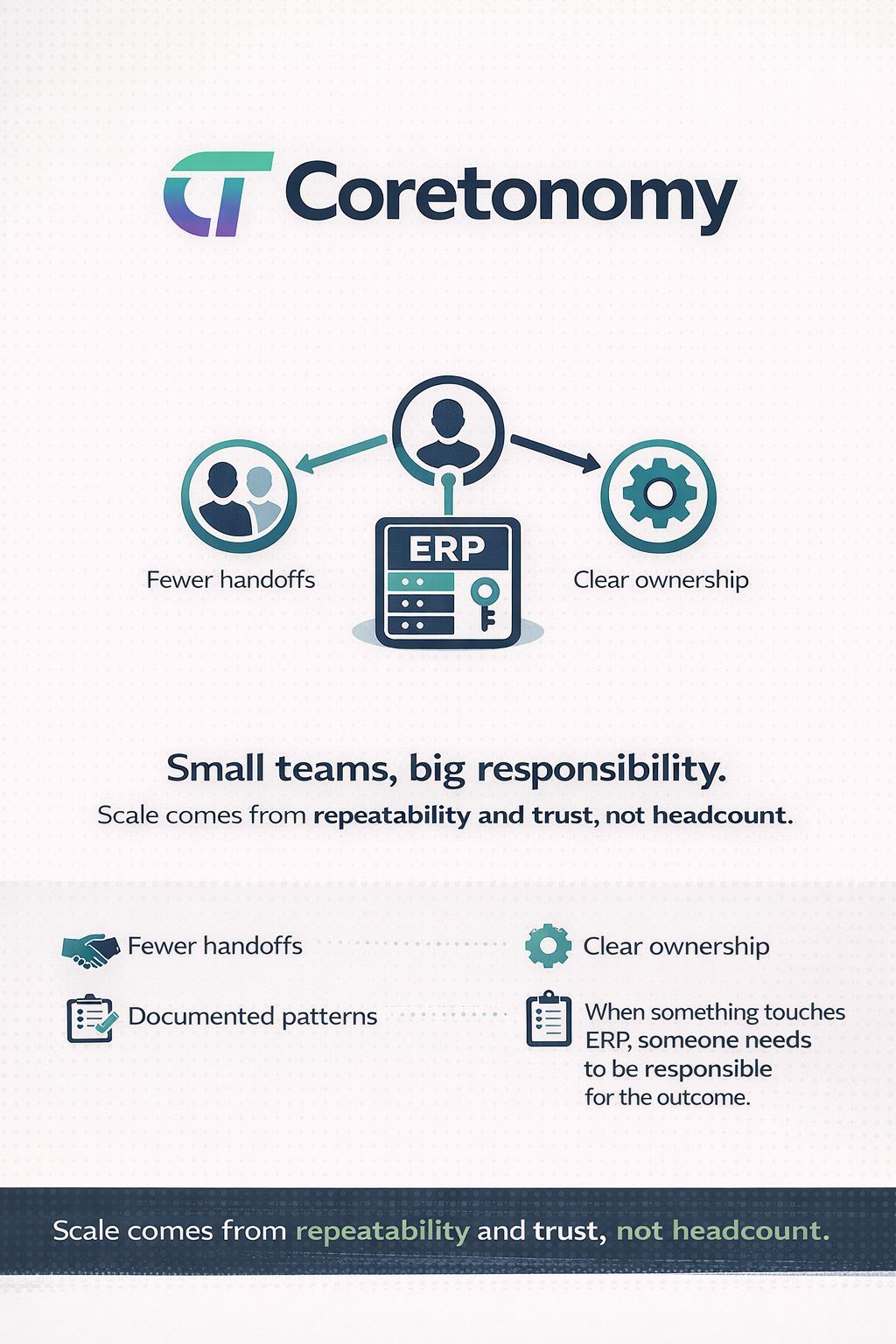
Growth in Headcount Does Not Equal Operational Stability
In technology services, size is often presented as reassurance.
Large teams. Multiple departments. Layered structures.
But in ERP integration — particularly within established wholesale and retail businesses — scale of personnel does not automatically translate into reliability.
In fact, the opposite often occurs.
Integration projects become unstable when accountability is diluted across too many roles, teams, and handoffs.
Why Integration Fails in Larger Delivery Structures
When a digital commerce or integration project touches ERP, responsibility cannot be abstract.
ERP is where operational truth lives. Changes here affect stock integrity, pricing accuracy, order flows, and financial data.
In larger delivery models, work frequently passes through:
- Sales teams
- Solution consultants
- Project managers
- Integration developers
- Third-party partners
Each step introduces interpretation. Each handoff introduces potential drift between intention and implementation.
No single point of ownership remains fully accountable for the operational outcome.
That is where risk accumulates.
This isn't only a structural argument — it's a measured one. QSM's analysis of nearly 1,060 IT projects compared teams of four or fewer people against teams of five or more, and found the larger teams cost three to four times as much and delivered two to three times as many defects for comparable work. QSM describes the schedule benefit bought in return as meagre (QSM: 4 key studies on team size).
Where larger teams did compress the schedule meaningfully, the trade was steep. In QSM's 2018 analysis, moving from fewer than four people to nine or more cut roughly 30% off the schedule — while increasing cost by around 350% and defects by around 500%.
The mechanism is coordination, not competence. Communication paths between people grow as n(n−1)/2: three people have three paths, ten people have forty-five. The effort of keeping everyone aligned rises far faster than headcount does. PMI's 2013 research puts a figure on what happens when that alignment fails — ineffective communication is the primary contributor to project failure roughly one third of the time (PMI: The Essential Role of Communications).
Both findings describe software and IT projects in general rather than ERP integration specifically. Our own view is that ERP integration is where they bite hardest, because the cost of a misunderstanding isn't a defect on a screen — it's stock, pricing or financial data that operations have already acted on.
The Principle Behind Staying Intentionally Small
Coretonomy has chosen to remain intentionally small for structural reasons, not resource limitations.
The operating principle is straightforward:
Integration fails when accountability is diluted.
Remaining small supports:
- Fewer handoffs between roles
- Direct responsibility for integration decisions
- Consistent engineering standards
- Reusable architectural patterns
- Clear traceability when changes are made
This structure protects the most critical part of the project — the integrity of systems connected to ERP.
When Something Touches ERP, Ownership Must Be Clear
In wholesale environments, ERP integration is not a peripheral task. It is core infrastructure.
Decisions about:
- Data flows
- Order synchronisation
- Pricing logic
- Stock updates
- Exception handling
have operational consequences beyond the digital channel.
When ownership is unclear, issues are often attributed to "the integration" rather than a responsible decision-maker. That ambiguity delays resolution and increases business disruption.
Clear ownership shortens feedback loops and protects operational continuity.
This is the same governance principle covered in more depth in Integration Ownership — The Governance Factor Behind Successful ERP Projects: clear ownership isn't a nice-to-have, it's what determines how fast a problem actually gets fixed.
Scale Through Repeatability, Not Headcount
Sustainable scale in integration delivery comes from:
- Documented patterns
- Proven architectural approaches
- Controlled change management
- Reusable integration structures
This is engineering scale, not staffing scale.
When patterns are repeatable, projects do not depend on constant reinvention. Each new implementation benefits from prior knowledge, reducing variability and improving predictability.
That predictability is what established wholesale businesses value most.
Trust Is Built Through Accountability
Wholesale and retail businesses with ERP-centric operations tend to be risk-aware and operationally experienced.
They understand that technology projects are not just technical exercises — they are operational events.
Trust is not built by presenting a large team.
It is built by demonstrating:
- Clear responsibility
- Transparent decision-making
- Structured delivery methods
- Measurable control over change
A smaller, accountable team can often provide more operational assurance than a larger, distributed one.
The Relationship Between Size and Risk Control
When delivery structures grow, complexity grows with them:
- More communication layers
- More coordination overhead
- More variation in implementation approaches
Integration risk increases not because individuals lack skill, but because system coherence becomes harder to maintain.
An intentionally small structure reduces this internal complexity, allowing more focus on the external complexity of ERP, ecommerce platforms, and channel integrations.
Why This Matters for Wholesale Digital Growth
Wholesale digital transformation involves:
- ERP integration
- B2B ecommerce platforms
- D2C channels
- Marketplaces
- Sales agent tools
- Operational reporting
Each connection increases architectural responsibility.
A delivery model built around clear ownership and repeatable engineering patterns reduces the likelihood that growth introduces operational instability.
That alignment between structure and responsibility is deliberate.
If you're weighing this up for your own project, When Coretonomy Is (and Isn't) the Right Fit for Your eCommerce Integration sets out the specific situations where this small-team, ERP-first model is — and isn't — the right match.
Conclusion
Staying small is not a constraint. It is an architectural decision.
In ERP integration work, reliability depends less on organisational scale and more on:
- Accountability
- Consistency
- Documentation
- Engineering discipline
Scale in this context comes from repeatability and trust — not headcount.
Staying Small in ERP Integration: Common Questions
Why does a smaller delivery team reduce ERP integration risk?
Fewer people means fewer handoffs, and each handoff is a point where intention can drift from implementation. Research on software project teams consistently finds that larger teams carry disproportionately more coordination overhead, more defects and more cost for comparable work — not because of skill, but because communication paths grow faster than headcount does.
Isn't a bigger team faster for large ERP integration projects?
Sometimes, but the trade is a poor one. QSM's analysis of nearly 1,060 IT projects found larger teams achieved only meagre schedule compression while producing two to three times the defects at three to four times the cost. In QSM's 2018 study, where a larger team did cut roughly 30% off the schedule, it did so with around 350% more cost and 500% more defects. Speed bought that way tends to be repaid during testing and after go-live.
How does Coretonomy stay accountable without a large team?
Through documented, repeatable integration patterns and clear single-point ownership for anything that touches ERP — so responsibility for an outcome never gets diffused across multiple roles, teams or handoffs.
Does staying small limit how much Coretonomy can scale?
No — scale comes from repeatable engineering patterns and proven architecture, not from adding headcount.
This is the approach behind our Brightpearl integration hub: the ERP stays authoritative while channels are added, changed or retired around it.