
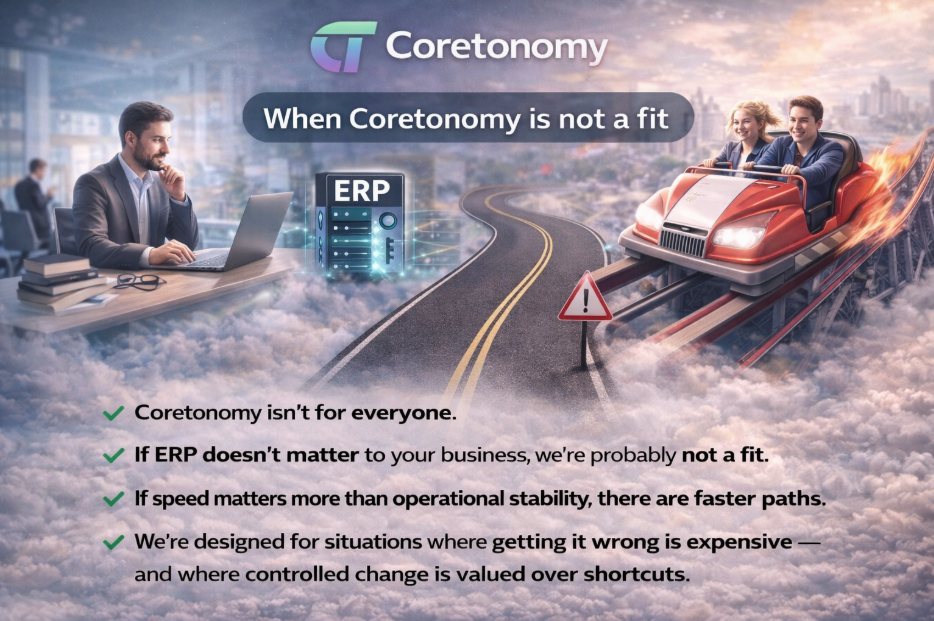
Not Every Business Needs an ERP-First Approach
In digital commerce, many providers try to position themselves as universally applicable.
That is rarely credible in ERP-centric wholesale environments.
Coretonomy is designed for a specific type of business and a specific risk profile. When those conditions aren't present, alternative approaches may be more appropriate.
Clarity about fit reduces wasted time and misaligned expectations.
When Coretonomy Is Likely Not the Right Choice
There are scenarios where the Coretonomy approach may not align with a business's priorities.
If ERP Does Not Matter Operationally
In some organisations, ERP plays a limited role, or operations are structured in ways that do not depend heavily on centralised data integrity.
In those cases, lightweight ecommerce setups or rapid storefront solutions may be sufficient. The architectural discipline required to keep ERP central may not provide proportional value.
If Speed Outweighs Operational Stability
Some businesses prioritise rapid experimentation, frequent platform changes, and short-term digital gains.
These strategies can be effective in environments where:
- Operational complexity is low
- Data integrity risks are manageable
- Systems can be replaced without significant disruption
Coretonomy's approach is not built around rapid iteration at the expense of structural control.
Where Coretonomy Is Designed to Operate
Coretonomy is built for situations where the cost of getting integration wrong is high.
These environments typically include:
- Established wholesale or retail operations
- Complex pricing structures
- ERP-dependent processes
- Multi-channel growth plans
- Operational teams sensitive to system disruption
In these contexts, ecommerce is not just a sales tool. It becomes part of the operational fabric of the business.
Mistakes here are not minor inconveniences — they affect stock accuracy, financial reporting, and customer relationships.
"Expensive" here is not rhetorical. Gartner predicts that by 2027, more than 70% of recently implemented ERP initiatives will fail to fully meet their original business case goals, with as many as 25% failing catastrophically (Gartner, What IT Leaders Must Do to Avoid Disappointing ERP Initiatives). Panorama Consulting, which surveys organisations on completed enterprise software projects, reports in its 2026 study that more than a quarter went over budget and almost a quarter over schedule — with unexpected additional technology needs the most common cause of the overspend (Panorama Consulting Group, The 2026 ERP Report).
Read together, those two findings say something more specific than "ERP projects are risky", and the reading is ours: most of these projects do go live, and most do not blow the budget. What a majority miss is what they were supposed to deliver. For a wholesale business, that gap is not an accounting entry — it is stock data, pricing and order flows running on a system nobody quite trusts, for months at a time. That is the specific risk profile this approach is built to reduce.
Controlled Change vs. Shortcuts
Digital transformation often presents a false choice between progress and caution.
Coretonomy's position is that controlled change enables sustainable progress.
This means:
- ERP remains the system of record
- Integration architecture is deliberate
- Channel expansion follows structured patterns
- Operational impact is considered before technical change
Shortcuts can accelerate early milestones but frequently introduce rework, reconciliation issues, and system instability later.
Controlled change reduces the likelihood of those second-order problems.
We cover the operational side of this trade-off in more detail in Scaling Carefully: Why Sustainable Growth Matters — what controlled, staged growth actually looks like in practice, versus the shortcuts that create rework later.
The Role of Risk in Technology Decisions
Technology decisions are rarely just technical.
They represent risk decisions.
Choosing an ERP-centric integration approach reflects a business decision that:
- Data integrity matters
- Operational continuity is critical
- System reliability outweighs rapid experimentation
- Long-term stability is valued over short-term convenience
Not every organisation operates under these constraints. But for those that do, architecture must reflect that reality.
Why This Clarity Matters
When expectations about pace, risk tolerance, and system importance are aligned, projects run more predictably.
When they are not, friction appears in the form of:
- Scope disputes
- Integration redesigns
- Delays caused by late-stage operational concerns
Being explicit about fit prevents these issues before they arise.
This is closely tied to why ERP has to stay the system of record as channels multiply — see ERP Stability: The Foundation for Multi-Channel Growth for how that plays out operationally.
Conclusion
Coretonomy is not intended to serve every ecommerce scenario.
It is designed for ERP-centric businesses where:
- Operational stability is non-negotiable
- Integration errors are costly
- Change must be controlled
- Long-term system integrity matters
In those environments, the value lies not in speed alone, but in reducing the risk of disruption as digital channels expand.
Running SAP Business One? See how SAP Business One ecommerce integration works when the ERP stays in control.
Is Coretonomy the Right Fit? Common Questions
How likely is an ERP-linked project to miss its objectives?
Gartner predicts that by 2027, more than 70% of recently implemented ERP initiatives will fail to fully meet their original business case goals, with as many as 25% failing catastrophically. Panorama Consulting's 2026 survey data shows more than a quarter of projects going over budget and almost a quarter over schedule. The common thread is not that these projects collapse — it is that they go live and under-deliver against what was promised.
What kind of business is Coretonomy NOT a good fit for?
Businesses where ERP plays a limited operational role, or where rapid experimentation and frequent platform changes matter more than long-term data integrity. Lightweight ecommerce tools are usually the better fit there, and the architectural discipline of an ERP-first approach will not return proportional value.
Does "controlled change" mean slower delivery?
Not necessarily slower overall. It means the pace is set by what the operational risk can absorb, rather than by how fast a feature can technically be shipped. The time saved by avoiding rework and reconciliation issues later often offsets a more deliberate start.
How do I know if my business fits the "getting it wrong is expensive" profile?
If a data or system error in your commerce stack would affect stock accuracy, financial reporting or customer-facing pricing — rather than being a contained inconvenience — you are in the risk profile this approach is designed for.